Become a Postdoc
A Postdoctoral Fellow is an individual who has received clearance to graduate with a PhD within the last five years and is now working mainly on research under the supervision of a faculty member from the University of Regina, as defined in the CUPE 5791 Research Collective Agreement.
Appointments normally involve substantial research and scholarship work, and may also involve some teaching (a maximum of two courses per academic year) as stipulated in the letter of offer. Postdoc appointments are temporary and normally don’t exceed three years, including renewals.
View the Steps to Becoming a Postdoc.
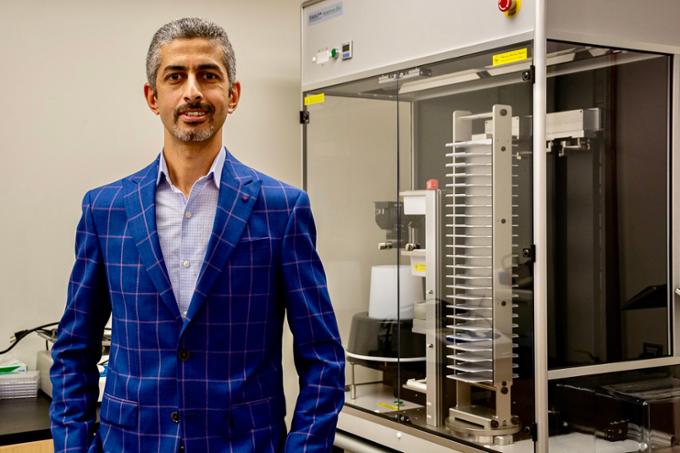
Omar El-Halfawy, PhD
Canada Research Chair in Chemogenomics and Antimicrobial Research
department of chemistry and biochemistry
"Postdocs play an active role in the research enterprise. While some postdoctoral fellows may feel stuck between being a student and an independent professional, postdoctoral training presents a vital step for the career progression of many PhD holders. Postdocs bring diverse perspectives from their past training while learning new approaches and systems, enriching their training experience and the research environment where they are. In my group, postdocs and other trainees find themselves in a collaborative, inclusive environment of scientific inquiry that respects everyone's expertise and contributions with an emphasis on individuals' career development."
Steps to Becoming a Postdoc
If you are interested in pursuing a postdoctoral opportunity at the University of Regina, we recommend that you:
- Connect wtih a potential supervisor.
- Identify a faculty member whose research aligns with your expertise. A directory of faculty members by department is available here.
- Reach out to that faculty member directly to inquire about potential opportunities as your supervisor.
- When contacting a potential supervisor, it is helpful to include:
• A brief statement of interest
• A description of your expertise and how it matches their research program
• Your CV
• Unofficial transcripts
- Develop a research proposal
- Interview
- Secure funding through NSERC or SSHRC.
- Appointment procedures
Appointment Procedures
After the research proposal and funding have been finalized, the supervisor will produce a conditional letter of offer, then the dean of the faculty will approve the position and its posting (if applicable), and will initiate the workflow. Appropriate work permits will be obtained (if applicable) and a formal offer of employment from the faculty dean will be produced through Human Resources. Postdocs coming from outside Canada need to collect all documents required to enter and work in Canada prior to beginning their appointment at the U of R. International postdocs can be exempted from the Labour Market Impact Assessment, but there is that a fee required to be paid to Citizenship and Immigration Canada. Postdocs or supervisors should contact Human Resources for assistance in the processing of a Labour Market Impact Assessment Exemption.
Postdoc-related inquiries can be directed to postdocs@uregina.ca.
Postdoctoral Success
Dr. Miranda Fields
 Dr. Miranda Field has recently transitioned into the role of Assistant Professor in Educational Psychology within the Faculty of Education. Prior to her appointment, she was a CIHR-IHSPR Health System Impact Postdoctoral Fellow embedded with the Saskatchewan Health Authority and the University of Regina. Her work bridges mental health, education, and Indigenous health systems through implementation science and learning health system approaches.
Dr. Field’s research focuses on strengthening youth mental health and addictions services, particularly in Indigenous and rural communities, by embedding evidence-informed decision-making directly within health and education systems. Her work integrates policy analysis, program evaluation, and knowledge translation to move research into real-time action. Grounded in relational accountability, interdisciplinary collaboration, and a commitment to ensuring that data is not only collected, but used to improve care, policy, and community outcomes.
Summary of Postdoctoral Research and Impact
Dr. Field’s postdoctoral work as a CIHR-IHSPR Health System Impact Fellow focused on strengthening youth and Indigenous mental health systems in Saskatchewan through embedded research. Based within the Saskatchewan Health Authority, she worked with system leaders, front-line providers, and Indigenous partners to co-design and evaluate services addressing documented gaps in youth mental health and addictions care. Her work responded to urgent system pressures—long wait times, fragmented pathways, and the need for culturally responsive approaches—and applied implementation science and Learning Health System principles to turn data into actionable knowledge that supports real-time decision-making and continuous improvement. This included contributing to cross-sector efforts aligned with Recommendation #9 of the Saskatchewan Advocate for Children and Youth’s Desperately Waiting report.
Beyond individual projects, her fellowship demonstrated how embedded researchers can strengthen organizational capacity for evidence-informed decision-making while building sustainable partnerships across health, education, and community systems. Her contributions also advanced national dialogue on embedded research and learning health systems, including publications in Learning Health Systems and Policy Options. She additionally co-founded Third Loop Health Inc., a national social research consulting firm advancing equity-centered mental health systems transformation.
Throughout the fellowship, Dr. Field completed extensive professional development, including the Knowledge Translation Professional Certificate through SickKids and the University of Toronto, advanced training in Global Health Delivery through Harvard University, and Researcher Management and Leadership training through the University of Colorado. She co-planned and hosted the national HSIF Cohort Retreat and was selected for Science Meets Parliament, strengthening her policy literacy, national networks, and leadership capacity for applied systems change.
Dr. Amy Richter
 Dr. Amy Richter is currently an Assistant Professor of Environmental Systems Engineering in the Faculty of Engineering and Applied Science at the U of R. Prior to working at the university, she spent 5 years as a Senior Policy Analyst – Waste Stewardship, with the Saskatchewan Ministry of Environment. Her work with the ministry included development of Saskatchewan Environmental Code chapters for transfer stations and compost facilities, as well as work to develop new regulations for the construction and operation of landfills in Saskatchewan. While working with the ministry, Amy also took on a part-time post-doctoral position at the University of Regina, under the supervision of Dr. Kelvin Ng, which allowed her to continue to contribute to data-driven policy on waste management. Amy is a proud alumnus, having earned all of her degrees from the University of Regina.
Short summary of post-doctoral research/impact & outcomes
As a postdoctoral researcher at the University of Regina, and under the guidance and supervision of Dr. Kelvin Ng, Amy contributed to research on extended producer responsibility, textile waste, and food waste. Canadians have one of the highest waste generation rates in the world, and although there is certainly more of a focus on waste management now than there used to be, there is still a need for data-driven information to help develop, improve and advance waste policy. Amy’s contributions have helped to quantify how well recycling programs are operating across Canada and identify ways to improve outcomes for recycled materials.
The University of Regina has been a great place for me to carry out research and gain professional and practical experience. As a graduate student and post doc, I loved getting to come to the university every day because I knew the work I was doing was making important contributions. I was given the opportunity to carry out my own research, while also being involved in many other projects at the University. I also had the opportunity to work with and mentor an amazing group of graduate students. I am so lucky to be coming back to the University of Regina, and can’t wait to see what we can achieve, together.