
Honorary Degrees
Awarding Honorary Degrees
The University of Regina Act gives Senate and Executive of Council joint authority to approve honrary degree candidates. The Chancellor confers honorary degrees as recommended by the President who makes selections from the approved candidate list.
The Senate by-laws provide for a Joint Committee of Senate and Council on Ceremonies, which recommends appropriate guidelines and criteria for the awarding of honorary degrees, invites, receives and reviews suggestions for candidates to whom honorary degrees might be awarded, and recommends for approval to Senate and Council candidates for honorary degrees.
Principles/Statement of Purpose
An honorary degree is the highest honour the University can bestow. Acceptance of an honorary degree by a candidate brings honour to both the recipient and the University.
Honorary degrees will be conferred at every convocation but not necessarily every ceremony.

Honorary Degree Categories
The University of Regina awards four honorary degrees:
- Doctor of Fine Arts honoris causa (DFA) – awarded in recognition of outstanding achievement in visual or performing arts.
- Doctor of Laws honoris causa (LLD) - awarded in recognition of exceptional service to the University or the community at large. This generic honorary degree is the most frequently awarded.
- Doctor of Letters honoris causa (DLitt) – awarded in recognition of outstanding achievement in the humanities or literature.
- Doctor of Science honoris causa (DSc) – awarded in recognition of outstanding achievement in the pure and applied sciences.
Categories of Nomination
The Ceremonies Committee will take the following considerations into account when selecting candidates:
- A Saskatchewan or prairie figure, well known and respected regionally for distinguished work which has earned them a reputation in public service.
- A distinguished person from a professional field or the creative arts field who is recognized as having achieved a reputation for excellence.
- A scientist, humanitarian, public servant or public figure who is recognized nationally or internationally for distinguished work and reputation.
- A visionary leader whose presence at Convocation would be inspiring to the graduating class.
On occasion, special efforts may be made to mark the time or circumstance by placing special emphasis on some particular field of endeavour.
Exclusion List
The following persons are not eligible for consideration for an honorary degree:
- current members of the Board of Governors or Senate (excluding Chancellors Emeriti);
- current or recent members of the faculty or staff of the University;
- current students; and
- holders of elected office at any level (such as municipal, provincial, or federal)
Nomination Forms
Nomination Process
Any member of the University community or the public may put forward a nomination. The nomination must be signed by the nominator and may include up to three letters of support. Nominators should declare on the nomination form the basis for their selection. Nominators would not normally be members of the nominee’s immediate family.
Nominations are accepted at anytime throughout the year.
Guidelines for Preparation of Nominations
Nominations should follow the format stipulated on the Nomination Form and include the following:
- The name of the nominee and complete contact information.
- Biographical information on the candidate, i.e. degrees, curriculum vitae, etc.
- A summary statement on why the candidate is being nominated.
- References (optional - maximum of three)
Please download the Nomination Form (Word Document). Once you have completed the form, submit it to the Joint Committee of Senate and Council on Ceremonies.
Contact Us
Please address and submit nominations to:
Joint Committee of Senate and Council on Ceremonies
Administration-Humanities Building, Room 510
University of Regina
Regina, SK S4S 0A2
Email: University.Secretary@uregina.ca
Telephone: 306-585-4956
Honorary Degree Protocol
The Ceremonies Committee will consider only complete nominations. The Committee will either recommend the nominee to Senate and Executive of Council for inclusion on the approved candidate list, or reject the nomination. If a nomination is rejected the file is destroyed.
Information on the action of the Ceremonies Committee regarding nominations will remain confidential.
The Senate and Executive of Council will, at their next meeting, receive the names of those recommended for approval and will vote on each name separately at an in-camera session. In unusual cases, such as a Special Convocation, such voting may take place by mail or confidential e-mail ballot. Those approved for the awarding of a degree will be added to the list of “approved” candidates, which is maintained by the University Secretary.
Prior to each Convocation ceremony, the President will review the approved list of honorary degree candidates and will chose the recipients to be honoured at the Convocation. Wherever practical, honorary degrees will be awarded within five years of their approval by Senate and Executive of Council.
If a nominator informs the nominee, or any one else, about the nomination, it must be on the basis that such communication is to be treated as strictly confidential communication and on the basis that such nomination is but a first step in a process which may or may not result in an honorary degree being awarded. The University will not release the outcome of any individual nomination, except by making a public announcement of the honorary degree recipients for a particular Convocation. The names approved by Senate and Executive of Council will not be made public until this time. Members of Senate and Executive of Council are to treat as confidential any information regarding approved candidates.
The University Secretary will determine the timing of the public announcement.
Honorary degree recipients may be invited to give a Convocation address but can decline the invitation to do so.
Honorary degrees are not awarded in absentia. An exception may be made only when an honorary degree recipient has accepted and arrangements have been made for its awarding but extenuating and unforeseen circumstances (such as sudden ill health or inability to travel) prevent the individual’s attendance.
Honorary degrees are not awarded posthumously. An exception may be made only when the honorary degree recipient has accepted and arrangements have been made for its awarding prior to the individual’s death.
The citation for the honorary degree is prepared by the University Secretary, in consultation with the President and in partnership with the presenter. The Chancellor confers the honorary degree, the University Secretary hoods the honorary degree recipient, and the President presents the framed honorary degree parchment.
Honorary degree recipients wear a scarlet wool gown trimmed with gold silk around the collar and down the front. The honorary degree hood, which is presented to the honorary degree recipient at the ceremony, has a shell of scarlet wool lined with gold silk with an inverted green silk chevron and colors distinctive to the degree.
- DFA – red with gold lining and a green chevron in the lining, and a narrow white and pink chevron above the green chevron;
- LLD– red with gold lining and a green chevron in the lining;
- DLitt– red with gold lining and a green chevron in the lining, and a narrow white chevron above the green chevron; and,
- DSc– red with gold lining and a green chevron in the lining, and a narrow mint green and emerald green chevron above the green chevron.
The Senate, acting on the recommendation of Council or on its own initiative but after receiving a report from Council, may revoke degrees (including an honorary degree), diplomas, certificates or distinctions conferred by the University and all privileges connected therewith from any holder of the same:
- who shall have been convicted of any criminal offence which shall be held (by the Council) to be of an immoral, or scandalous or disgraceful nature;
- whose membership in a Professional Society has been revoked for misconduct; or
- whose conduct, in the opinion of the Senate, shall constitute a breach of any agreement made with the University as a condition of the conferment of such degree or degrees, diplomas, certificates or distinctions (including institutional honours).
The Senate may restore the degree, diploma, certificate or distinction or privileges revoked by Senate without further examination, on cause being shown, and after report by Council.
Honorary Degree Recipients
2026 Honorary Degree Recipients
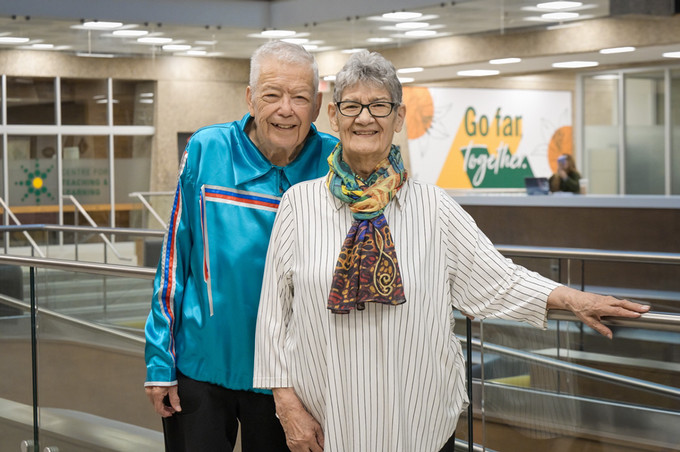
Drs. Sol and Elsie Sanderson
For decades, Sol and Elsie Sanderson have dedicated their lives to strengthening Indigenous governance, education, culture, and community. Together, they have helped shape institutions and ideas that have had a lasting impact across Saskatchewan and Canada.
Beginning his political life at the age of 15, Sol Sanderson became one of the country’s most influential First Nations leaders. He played a key role in securing constitutional recognition of Aboriginal and treaty rights through Section 35 of the Constitution Act, 1982, and helped establish institutions including First Nations University of Canada, the Saskatchewan Indian Institute of Technologies, and the Saskatchewan Indian Cultural Centre.
Elsie Sanderson has devoted her life to preserving traditional knowledge and supporting families and communities. Her work has included leadership in Indigenous governance, cultural teaching, child welfare, and spiritual and community support. Throughout her life, she has been guided by a commitment to sharing knowledge and helping others.
Together, Sol and Elsie Sanderson have inspired generations through their commitment to Indigenous self-determination, education, and service. Their shared legacy reflects a lifelong dedication to building stronger communities and creating opportunities for future generations.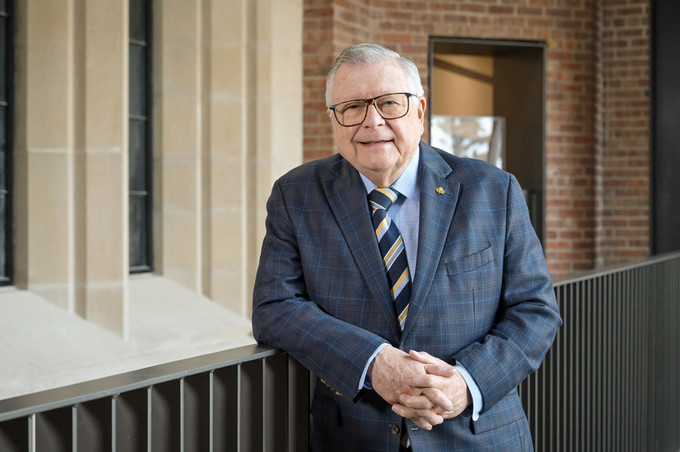
The Honourable Dr. Ralph Goodale
The Honourable Ralph Goodale has dedicated more than five decades to public service, representing Saskatchewan and Canada with distinction at home and abroad. Raised in Wilcox, Saskatchewan, he attended the Regina Campus of the University of Saskatchewan before earning a law degree and beginning a career that would make him one of the country’s most recognizable political leaders.
First elected to Parliament at the age of 24, Goodale went on to become Regina’s longest-serving Member of Parliament, representing the constituency of Wascana for 26 years. During his career, he held several senior cabinet portfolios under three prime ministers, including Agriculture, Natural Resources, Finance, Public Safety, and Government House Leader.
His work helped shape national policy and brought lasting benefits to Saskatchewan through investments in research, infrastructure, health care, and economic development. In 2021, he was appointed High Commissioner for Canada in the United Kingdom, where he continued to serve the country on the international stage.
A lifelong advocate for public service and democratic values, Goodale has received numerous honours and remains one of Saskatchewan’s most respected and accomplished statesmen.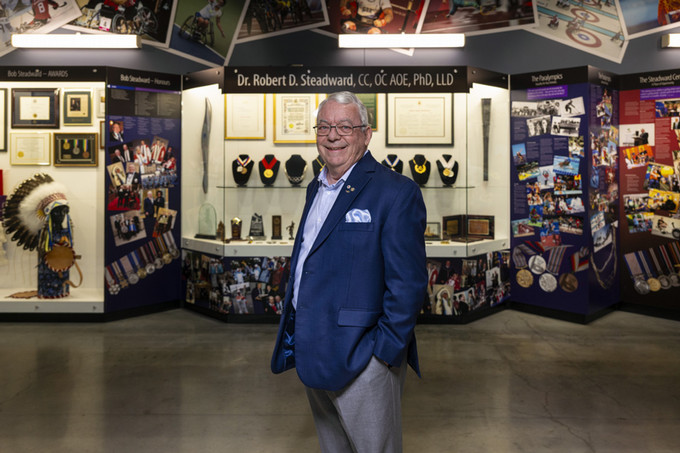
Dr. Bob Steadward
Born in Eston, Saskatchewan, and educated at Luther College High School in Regina, Dr. Bob Steadward has devoted his life to expanding opportunities for people with disabilities through sport, education, and advocacy. After earning degrees in physical education from the University of Alberta, he went on to become a professor and founded what is now The Steadward Centre for Personal and Physical Achievement, an internationally recognized model for adapted physical activity.
Steadward’s influence extended far beyond Canada when he became the founding president of the International Paralympic Committee in 1989. During his 12-year tenure, he helped unite organizations from around the world, strengthened ties with the International Olympic Committee, and helped elevate the Paralympic Games to unprecedented prominence.
His contributions have also included mentoring students and athletes, supporting Indigenous communities, and helping shape the successful bid for the 2010 Olympic and Paralympic Winter Games in Vancouver. His many honours include appointment as a Companion of the Order of Canada, the Alberta Order of Excellence, and induction into six halls of fame.
Through a lifetime of leadership and service, Dr. Bob Steadward has become one of Canada’s most influential voices for inclusion and accessibility.