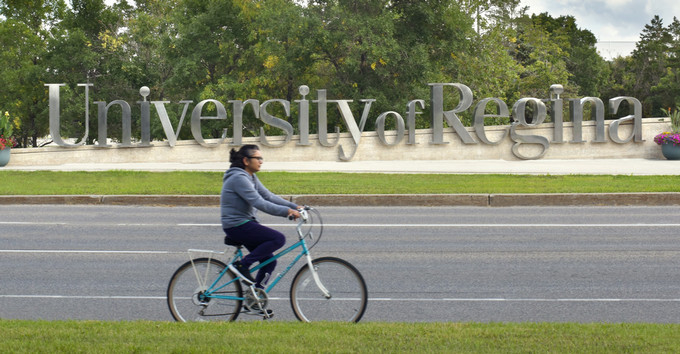
Choosing a university is one of the most significant investments a person can make, so considerations go far beyond the goal of hanging a degree or degrees on your wall. The challenging choice should include factors such as the kind of community you want to join, knowing your finances will be manageable, and having access to opportunities that will help launch your career before convocation.
Whether you're in high school nearby or an international student weighing your options from thousands of kilometres away, our top five reasons to study at the U of R can help with the decision-making process.
1. Learn by doing and earning

Learning doesn’t stop at the lecture hall. U of R students build career-ready skills through hands-on, experiential learning that connects classroom theory to real-world outcomes. Photo Credit: University Communications and Marketing
Theory is essential, but experience gets you hired. The U of R pioneered co-operative education programing in Western Canada, and we remain the provincial leader in getting students out of the classroom and into the workforce.
Our students earn more than $10 million annually through work placements, with average earnings between $13,000 and $17,000 per four-month term. This isn’t just about pocket money; it’s about building a résumé that makes you stand out from the crowd. The results speak for themselves: according to the latest provincial government data, 87 per cent of U of R graduates are employed, with nearly half working in jobs directly related to their field of study.
For Shivang Chopra, an MBA student at the Hill Levene School of Business, the Centre for Experiential and Service Learning (CESL) helped bridge his past experience in India with his future in Canada.
“I secured a co-op position with the inventory control division at SaskPower, the leading crown corporation in Saskatchewan,” says Chopra. “My position empowered me to achieve a path where my capabilities could be better utilized by providing a much more encouraging and growth-centred environment. As an immigrant, uncertainty is a common companion, but through this placement and the Hill Levene School of Business, I have been able to create a roadmap for my future career trajectory.”
2. The “Saskatchewan advantage”: Affordability meets ROI

Ranked as the fifth Most Livable City in Canada (The Globe and Mail, 2024), the City of Regina in the province of Saskatchewan offers the perfect balance of affordability and economic opportunity to launch your career. Photo Credit: University Communications and Marketing
Let’s talk numbers. In an era of rising costs, Regina consistently ranks among Canada’s most affordable major cities (recently named the fifth Most Liveable City in Canada by The Globe and Mail). Yet value is about more than just low rent; it’s about Return on Investment (ROI).
Saskatchewan’s Graduate Retention Program (GRP) offers up to $24,000 in tax credits to graduates who stay and choose to work in the province, arguably the most aggressive retention incentive in the country. When you pair that with tuition rates that are competitive compared to Ontario or British Columbia, the financial picture becomes clear. To further ease the transition for new arrivals, the U of R also offers guaranteed on-campus housing for first-year students, providing safety, convenience, and an instant community.
Kaydence Hughes, a 3rd year undergraduate Psychology student at the Faculty of Arts, who also worked with CESL as a co-op student, notes that the lifestyle benefits go beyond the bank account.
“Saskatchewan is the cheapest province to live in,” Hughes explains. “The campus is gorgeous all year around, and it isn’t ginormous, so it’s unlikely to find yourself running from building to building trying to get from one class to another.”
3. World-class research impact
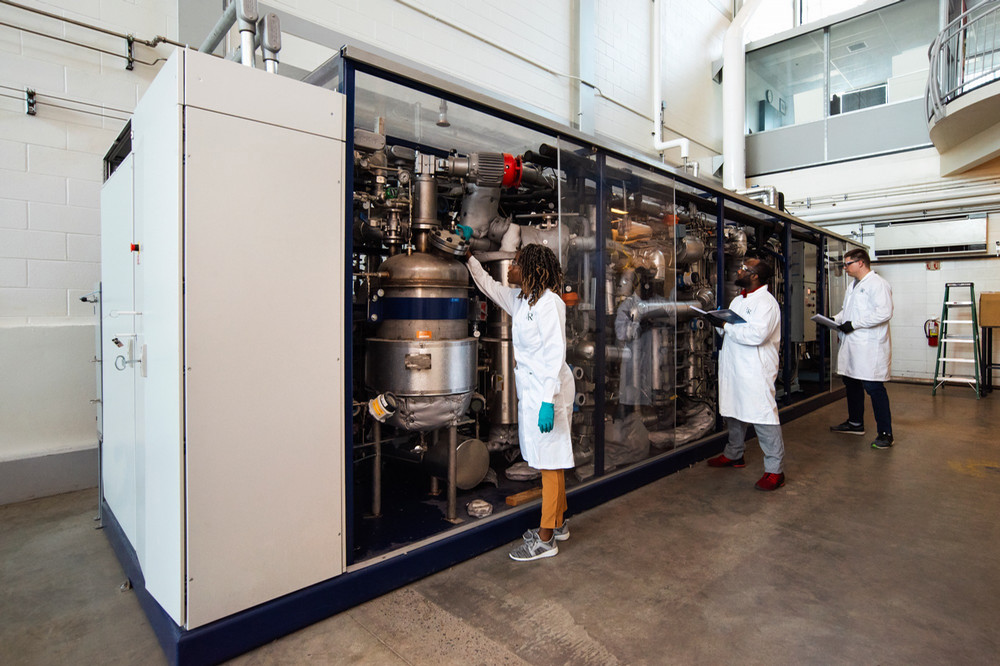
From clean energy to public safety, U of R students work alongside researchers tackling global challenges at the undergraduate and graduate levels. Photo Credit: University Communications and Marketing
Do not let the “prairie" label fool you; the U of R is a heavy hitter on the global stage. We were recently ranked No. 1 in Canada for Research Quality in Psychology by Times Higher Education (2025) and cracked the top 100 worldwide in the same subject area.
From the Clean Energy Technologies Research Institute (CETRI) leading the globe in carbon capture to the Canadian Institute for Public Safety Research and Treatment (CIPSRT) pioneering trauma therapy, our students are learning from the experts rewriting the textbooks. Unlike larger institutions where research is often reserved for PhD candidates, U of R undergraduates are frequently encouraged to participate in groundbreaking projects alongside their professors.
Hughes says this high-level expertise trickles directly down to the undergraduate experience.
“I’ve had multiple professors do extra research outside of their expertise just because one of their students asked a question,” Hughes says. “To me, that shows continued dedication to learning and to the field of psychology itself.”
4. You are never just a number
At larger institutions, it is easy to become invisible in a lecture hall of 600 people. At the U of R, we prioritize a “Circle of Support”, a comprehensive network designed to champion your well-being from orientation to graduation. Ranked sixth in Canada for Student Services (Maclean’s, 2026), this approach goes beyond basic advising to create a holistic safety net. By integrating the Student Success Centre, mental wellness services, and specialized academic coaching, we ensure that asking for help is never a bureaucratic obstacle, but a seamless part of your path to success.
For Dylan Rein, a 4th year Industrial Systems Engineering Student in the Faculty of Engineering, this easy access to instructors and labs turned potential academic struggles into success.
“With the U of R being a smaller institution, the smaller class sizes, especially in later years, make learning so much easier and more effective,” says Rein. “Being able to build closer connections with both teachers and fellow classmates makes the university experience feel more welcoming, easier, and all around enjoyable.”
5. A community that feels like family
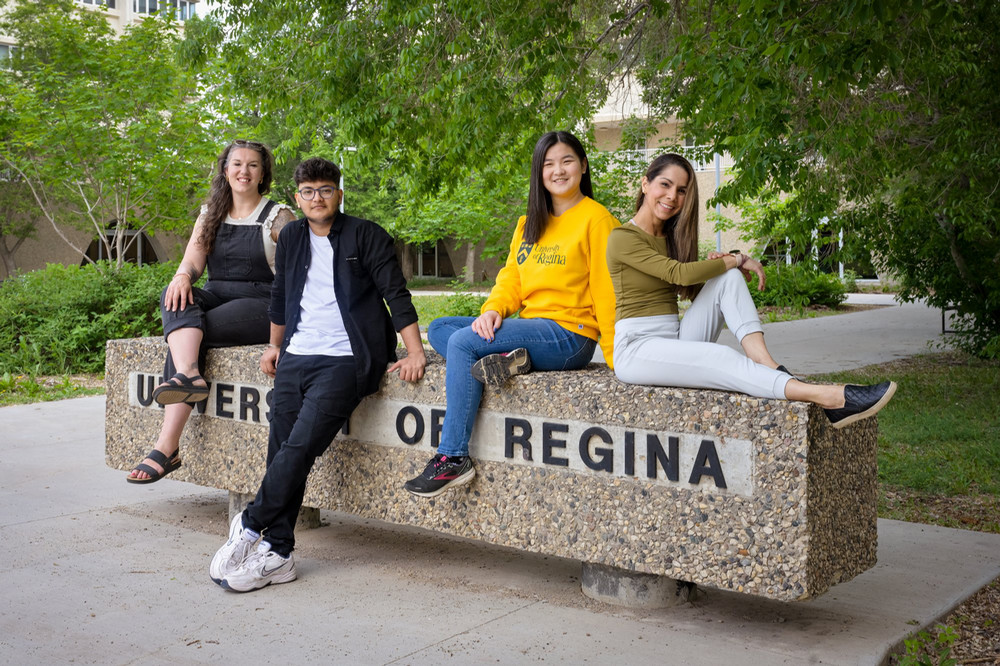
With students from over 100 countries and a supportive campus culture, you aren’t just joining a university, you are joining a global family that rejoices as you succeed. Photo Credit: University Communications and Marketing
With students from more than 100 countries walking the hallways, our campus is a microcosm of the world. However, unlike sprawling commuter campuses, the U of R fosters a tight-knit sense of belonging through dedicated hubs such as the ta-tawâw Student Centre and the Global Learning Centre. Whether cheering on student-athletes from the bleachers, grabbing food at Riddell Centre, or studying in the welcoming Archer Library, you feel like part of a community instead of a face in the crowd.
“The community here is warm and welcoming. It feels like more than an educational institution; it’s a family,” says Chopra. “You could be sharing a classroom with students from Iran, Nigeria, Peru, China, etc., each bringing the flavour and perspective of their cultures. If I had to pick again, I’d still choose the U of R.”
Ready to see where a University of Regina degree can take you? Explore more than150 undergraduate and graduate programs to find your perfect fit.
Banner Image: Room to breathe, space to grow. Situated within Wascana Park—one of North America’s largest urban parks, our campus offers an active, welcoming environment where nature and city life meet. Photo Credit: University Communications and Marketing
About the University of Regina
At the University of Regina, we believe the best way to learn is through access to world-class professors, research, and experiential learning. We are committed to the health and well-being of our more than 16,600 students and support a dynamic research community focused on evidence-based solutions to today’s most pressing challenges. Located on Treaties 4 and 6—the territories of the nêhiyawak, Anihšināpēk, Dakota, Lakota, and Nakoda peoples, and the homeland of the Michif/Métis nation —we honour our ongoing relationships with Indigenous communities and remain committed to the path of reconciliation. Our vibrant alumni community is more than 95,000 strong and enriching communities in Saskatchewan and around the globe.
Let’s go far, together.