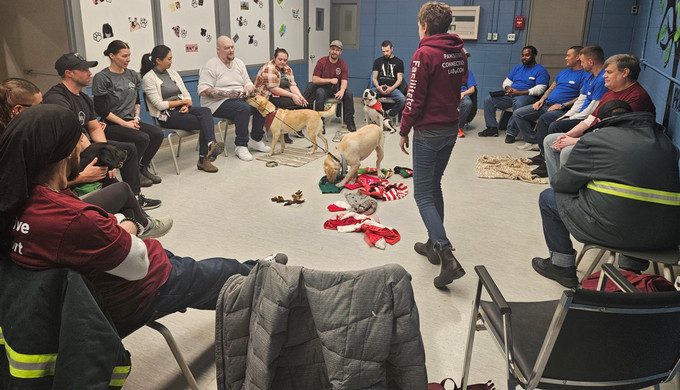
On a cold, dark Alberta winter morning, the gym inside the Drumheller’s federal correctional institution feels cavernous. Fluorescent lights hum. A basketball net hangs unused. At one end of the court, a small group of people unloads dog beds, crates, and leashes. Six dogs quietly move across the concrete floor.
At the far end, a door opens.
A line of men enters and stops at half court, unprompted. No one smiles. Arms are crossed. Bodies are rigid, guarded.
“I remember just thinking, oh my goodness,” says Rachel Hafner, a University of Regina Social Work student at the time. “Is this going to be an uncomfortable experience? Because in my head, I thought this was going to be so amazing.”
You meet these big, intimidating guys, prison tattoos, tough posture, and then you see them sitting on the floor with a dog, completely engaged. The dogs don’t know where they are. They are enjoying themselves. And that brings something out in people. — Rachel Hafner, Clinical Social Worker, Regional Psychiatric Centre
Hafner joined the project as part of her undergraduate practicum with the University of Regina’s Faculty of Social Work, assisting the PAWSitive Connections Lab — an initiative that brings people and animals together. The lab explores how structured, hands-on interaction with dogs can support trust, emotional regulation, and connection, especially in places where those things are often in short supply.
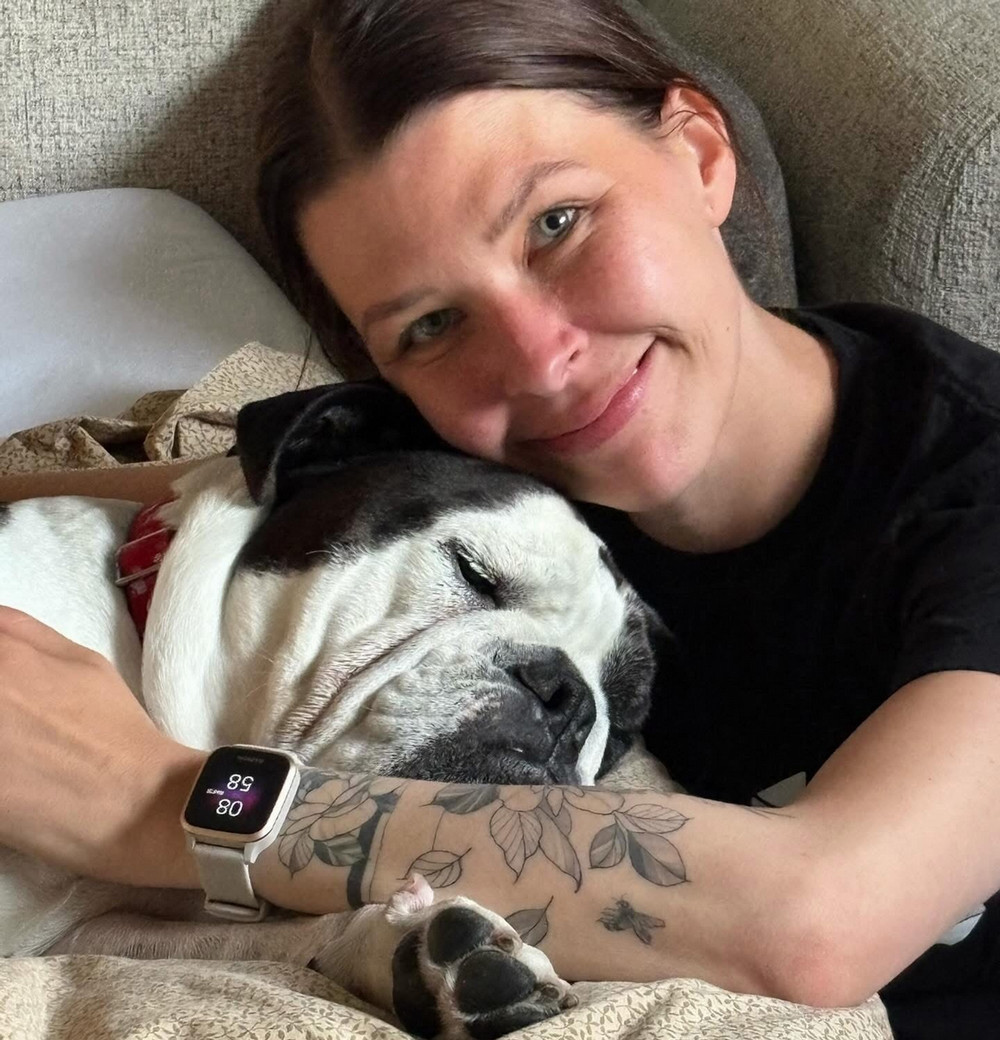
Rachel Hafner completed a Social Work practicum working with federal prisoners in a program that integrates dogs to help build trust and connection. Photo credit: Courtesy of Dr. Colleen Dell.
The lab was established in 2023 on the University of Saskatchewan campus. It builds on years of related work, says Dr. Darlene Chalmers, a professor in the U of R’s Faculty of Social Work and co-director of the lab.
“We wanted to create a central place for this work,” Chalmers says. “Not just to study it, but to understand what’s happening in communities and respond in ways that are actually useful.”
One of those requests came directly from the Drumheller Institution. After a rise in overdoses among the incarcerated population, the warden at the time contacted the research team to ask whether an animal-assisted program could help.
“He was very open to trying something different,” Chalmers says. “That openness shaped how the program began.”
Developed by Chalmers and Dr. Colleen Dell, a faculty member at the University of Saskatchewan, the Drumheller program runs over three days. Participants work in small groups with trained dogs and facilitators, learning basic handling skills, walking, training, and care. Just as important, there is time set aside to sit, interact, and simply be with the dogs.
“What’s unique about this experience,” Hafner says, “is that the guys get to handle the dogs. The leashes are in their hands.”
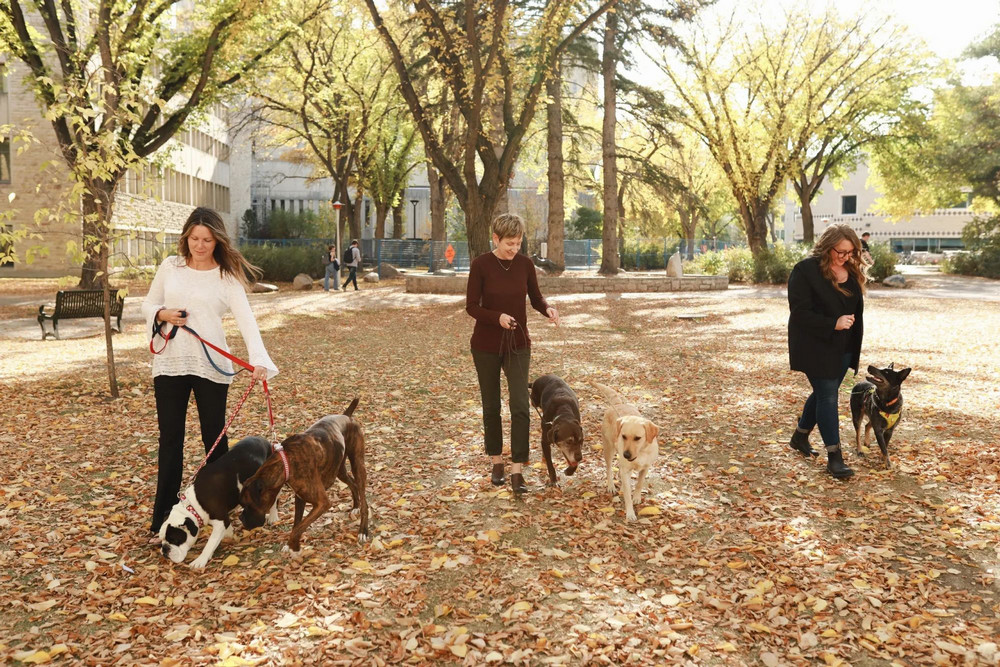
From left to right, Dr. Colleen Dell, Dr. Darlene Chalmers, and Dr. Linzi Williamson walk their dogs together. The three are the leadership team behind the PAWSitive Connections Lab, an interdisciplinary research initiative founded in 2016 that explores the health and social benefits of human–animal connection. Photo credit: Courtesy of Dr. Colleen Dell
That detail matters. In a correctional environment built around rules, schedules, and constant supervision, moments of choice are rare.
“For many participants, it creates a space where they can let their guard down,” Chalmers says. “We hear people say, ‘I can relax here. I can be myself.’ That’s not a small thing.”
Despite Hafner’s nerves on that first day, the program began to gain momentum quickly.
“I had worries going in,” she says. “But once it started, it was clear very fast that it was working. You could see the engagement. You could feel the shift.”
Attendance grew each day. By the third day, the program was at capacity.
At the heart of the program is an approach known as trauma-informed care —the idea that people’s behaviour is often shaped by what they’ve experienced, and that care should focus on safety, trust, and respect rather than control or punishment. Trauma-informed care doesn’t ask, “What did you do?” Rather it asks, “What happened to you?”
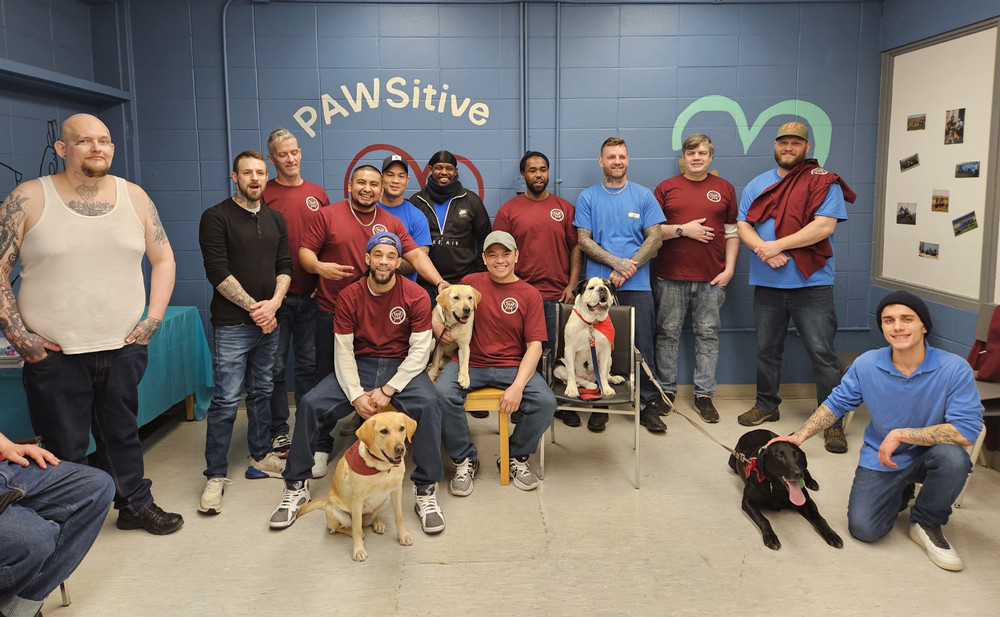
Participants of the PAWSitive Support program at the Drumheller Institution. Photo credit: Courtesy of Dr. Colleen Dell
“So many students don’t really know what trauma-informed care looks like in practice,” Hafner says. “You read about it in class and think it’s something you’re going to use on purpose. But through this program, you’re being trauma-informed without even knowing it.”
The dogs play a key role in that process.
“Dogs don’t outwardly appear to judge,” Chalmers says. “They don’t bring expectations into the room. That helps people feel safer, and it helps students learn what connection actually looks like.”
One moment in particular stands out for Hafner.
“We didn’t ask anyone to do this,” she says. “But on day two, the guys all brought photos of their pets.”
Some talked about dogs waiting for them at home. Others shared stories of animals they had to rehome when they were incarcerated.
“It was incredibly humanizing,” Hafner says. “That was the moment I knew the connection had really happened.”
For Chalmers, that kind of choice is central to the work.
“When people decide to share something meaningful, it tells you trust is present,” she says. “That’s the foundation of good social work practice.”
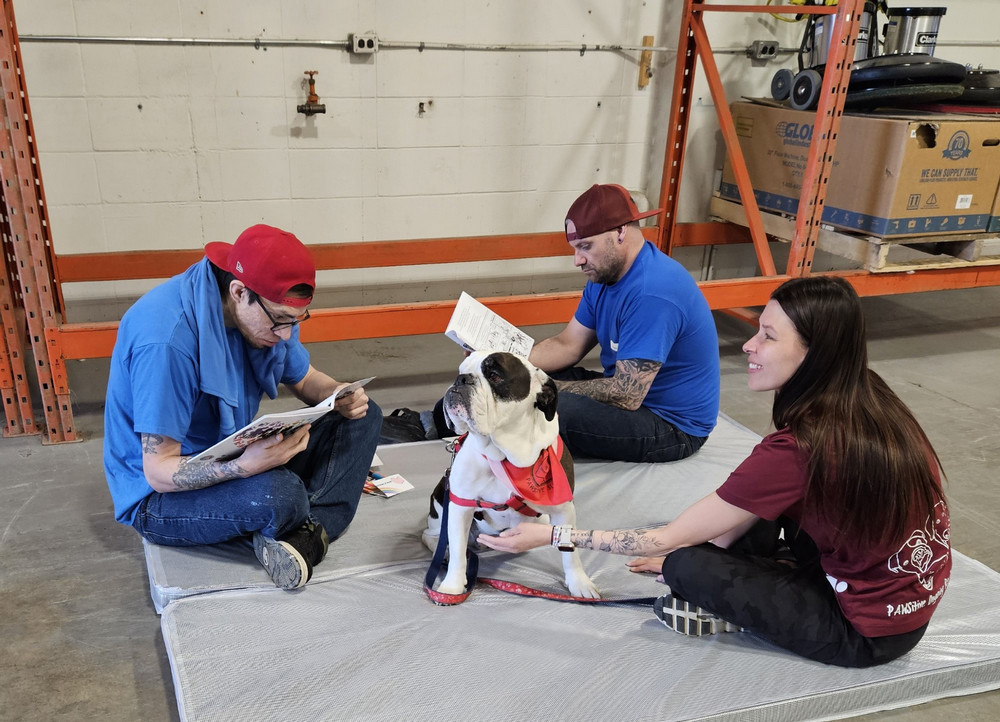
Rachel Hafner was a Social Work student when she got involved in the Pawsitive Support program helping federal prisoners through a workshop integrating dogs to bring connection and well-being. Photo credit: Courtesy of Dr. Colleen Dell.
The future of the Drumheller program is focused on strengthening and refining the work based on participant voices. With $10,000 in seed funding from the University of Regina’s Social Work Research Centre, Chalmers and her team are forming a participant advisory group to gather direct feedback, improve how the program is delivered, and shape future funding proposals, with a growing emphasis on substance use recovery and community reintegration.
While the PAWSitive Connections Lab is rooted in research, its impact is perhaps even more visible in how it shapes students. The University of Regina’s Social Work program in Saskatoon has become a key site for this kind of hands-on learning, placing students in unique settings where theory is tested in real time.
Hafner first encountered the program during her practicum at the Regional Psychiatric Centre in Saskatoon. Now a clinical social worker there, she continues to be involved in animal-assisted programming. Her experience at the Drumheller Institution reshaped how she sees the people behind the walls.
“You meet these big, intimidating guys, prison tattoos, tough posture, and then you see them sitting on the floor with a dog, completely engaged,” she says. “The dogs don’t know where they are. They are enjoying themselves. And that brings something out in people.”
Chalmers sees that shift as central to the profession.
“This work challenges stigma,” she says. “It reminds us that people are more than the worst thing that’s happened to them. These moments with the dogs don’t erase the realities of incarceration but they do show what’s possible when we make room for connection.”
For students like Hafner, these moments offer something just as lasting, a reminder that social work, at its core, begins not with instruction, but with relationship. And sometimes it begins with a dog quietly waiting for someone to reach out and scratch its ears.
Banner image: Dr. Darlene Chalmers leads a session with program participants at the Drumheller Institution. Photo credit: Courtesy of Dr. Colleen Dell.
About the University of Regina
At the University of Regina, we believe the best way to learn is through access to world-class professors, research, and experiential learning. We are committed to the health and well-being of our more than 16,600 students and support a dynamic research community focused on evidence-based solutions to today’s most pressing challenges. Located on Treaties 4 and 6—the territories of the nêhiyawak, Anihšināpēk, Dakota, Lakota, and Nakoda peoples, and the homeland of the Michif/Métis nation —we honour our ongoing relationships with Indigenous communities and remain committed to the path of reconciliation. Our vibrant alumni community is more than 95,000 strong and enriching communities in Saskatchewan and around the globe.
Let’s go far, together.
Charlie and Anna-Belle
Here's the story of “Charlie” and Anna-Belle. Click to listen (mp3)