A Faculty Commitment to Social Justice Means Committing to Queer and Trans Students and Education Workers
The Faculty of Education has an ongoing commitment to supporting queer and trans students. In response to concerns raised by students, the Faculty commissioned an external review in 2022, which yielded recommendations to enhance awareness, safety, inclusion, and a sense of belonging for sexual and gender minorities. Since then, the Faculty’s Sexual and Gender Diversity Working Group has hosted events, offered learning sessions, annually coordinated faculty engagement in Pride, purchased resources for the Teacher Preparation Centre, and more.
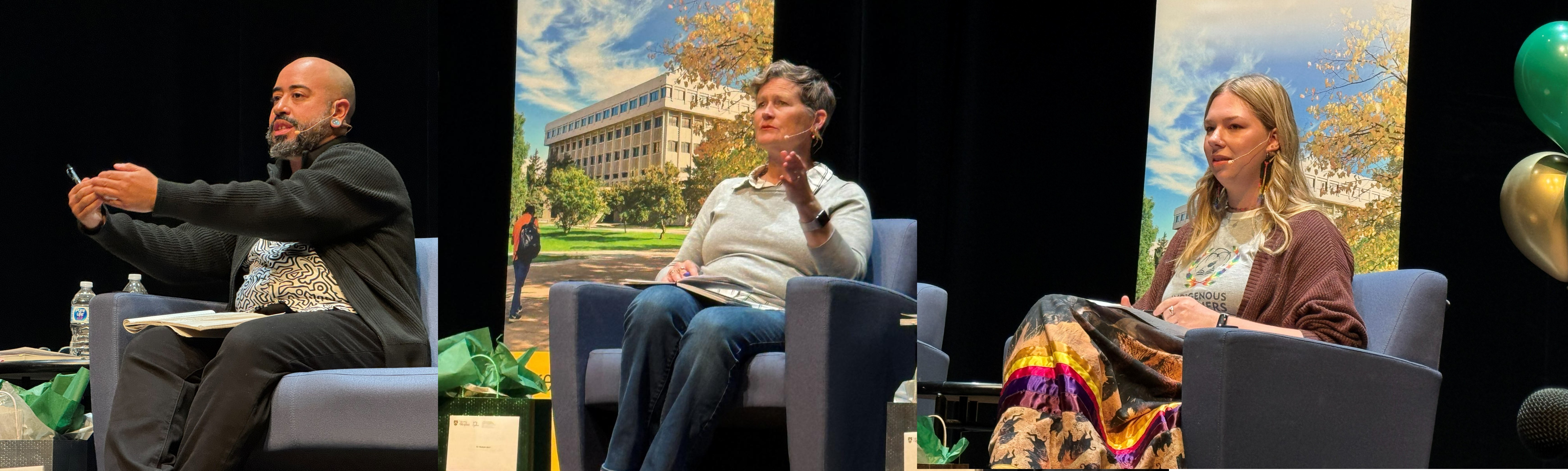
Building on this work, the Faculty recently hosted a panel discussion, Enacting Queer and Trans Justice in Schools, to further explore what justice looks like for queer and trans students and educators, and how schools can foster inclusive and affirming learning environments. This event followed an in-faculty book club with over 25 participating faculty members, sessional instructors, and graduate students, who gathered to read Queer Justice at School (Meyer, 2025) as they considered the role teacher education might play in queer and trans justice.
Enacting Queer and Trans Justice in Schools: A Call to Courage, Care, and Collective Action
On October 30, the University of Regina’s Faculty of Education hosted a thought-provoking panel discussion on queer and trans justice in K-12 schools. The event brought together three voices at the forefront of gender, sexuality, and education justice: Dr. Elizabeth Meyer (University of Colorado Boulder), Dr. Qui Alexander (The Ontario Institute for Studies in Education of the University of Toronto), and Madelaine Enns of Indigenous Teachers for Two-Spirit Youth (ITTSY).
Through personal stories, grounded research, and community-rooted perspectives, the panelists offered educators a path forward, one that honours diversity, challenges systemic harm, and centres belonging for 2SLGBTQIA+ youth.
Creating Conditions for Belonging
The discussion began by exploring what justice looks like for 2SLGBTQIA+ youth. Dr. Alexander emphasized that schools are often structured to exclude certain students. They urged educators to “imagine bigger,” envisioning educational spaces where students can be their whole selves without constantly negotiating their identities.
“In Indigenous communities, restoring sovereignty and allowing us to make our own decisions is crucial,” said Enns. “It’s a very individualized process, so avoiding the standardization that often happens in larger systems like education is important. It’s about letting communities determine what works for them.”
Dr. Meyer highlighted the urgency of making schools spaces of inclusion and affirmation. Drawing on three decades of K–12 experience, she noted, “Justice isn’t just about fairness. It’s about creating spaces where everyone feels whole, valued, and able to express their full humanity. Schools should foster curiosity, creativity, and the brilliance in every student, not just a narrow range of students deemed successful.”
Addressing Policy Challenges
Panelists discussed Saskatchewan’s Bill 137, which requires parental consent for students under 16 to use “gender-related” names or pronouns other than those indicated on their official identification (e.g., birth certificate) and its chilling effect in schools.
Dr. Meyer noted that the question is not only about compliance but about care: “When educators connect with students and empower them to articulate what they need, they help young people recognize their own strength and voice.” She highlighted the importance of supporting youth in identifying meaningful, manageable steps toward change, whether advocating privately or publicly.
Dr. Alexander added that curiosity is a powerful antidote to apathy: “When we foster curiosity, we resist the impulse to give up. It’s about asking what we don’t yet know: why a young person might feel unsafe talking to their parents, or what their silence is telling us.”
Enns connected this discussion to Indigenous perspectives on sovereignty and rights: “Indigenous peoples have the right to self-determination, which includes being called what we want to be called. Education justice means making space for that autonomy and helping communities decide what’s right for their young people.”
Intersectionality and Community
The panelists emphasized that racial justice, decolonization, and queer and trans inclusion are inseparable. Dr. Alexander noted, “Anti-racist work is queer-affirming work, and decolonial work is queer-positive work,” reminding educators that these movements share common roots. Dr. Meyer described systems of oppression as “branches of the same tree,” urging schools to build inclusive spaces where trans, Two-Spirit, and racialized youth feel that they belong.
Panelists also highlighted the importance of community connections in sustaining justice, especially for students experiencing multiple forms of marginalization.
Practical Support for Students
Throughout the conversation, moderator Dr. j wallace skelton encouraged the panelists to offer concrete strategies for educators:
- Stop misgendering students and respect their identities.
- Create systems of safety rather than relying solely on rigid rules.
- Stay curious and open to learning, even when it challenges assumptions.
- Recognize that students are experts in their own lives.
The Power of Collective Courage
Building on these insights, the panel reflected on the necessity of collective courage.
Meyer reminded attendees, “Courage grows in community. When we stand together, share resources, and speak truth, we model what justice looks like for our students.”
Alexander echoed this sentiment: “This work asks us to imagine otherwise, to believe a different kind of world is possible, even when we haven’t seen it yet.”
Moving Forward
In closing, the panel urged educators to co-create inclusive classrooms with their students.
True justice, they suggested, is not achieved through checklists or symbolic gestures, but through ongoing engagement, listening, and action. Educators hold both the responsibility and the power to shape school culture through everyday acts of inclusion, from language choices to curriculum design and classroom norms. As a Faculty of Education, we know this is true both in our classrooms, and the classrooms that our students teach in. We are committed to this on-going work.
About the Panelists
Dr. Elizabeth J. Meyer is a Professor of Educational Foundations, Policy, and Practice at the University of Colorado, Boulder, and the author of three books on gender and sexual diversity in education. She received the 2021 AERA Award for Distinguished Contributions to Gender Equity Research.
Dr. Qui Alexander (they/them) is an Assistant Professor of Gender, Sexuality, and Trans Studies in Curriculum and Pedagogy at The Ontario Institute for Studies in Education, University of Toronto. Their research focuses on Black trans studies, abolition, and transformative justice in education beyond formal school contexts.
Madelaine Enns (they/she) is a Michif, queer educator, and member of Gabriel Dumont Local #11, with ancestral ties to Gordon’s Reserve in Punnichy, SK and Red River. They are from Treaty 5 but grew up mainly in Saskatoon on Treaty 6. She has been in a communications role with Indigenous Teachers for Two-Spirit Youth (ITTSY) since it was created. ITTSY is a group of First Nations, Métis, and Inuit educators dedicated to supporting Two-Spirit youth in Saskatchewan’s K–12 education system. Madelaine currently works for the Saskatoon Sexual Health as their Indigenous and Cultural Coordinator. Madelaine graduated with distinction from SUNTEP in 2023 at the University of Saskatchewan and recently started her master’s in educational administration with a focus on Indigenous leadership and organization.
j wallace skelton (moderator, no pronouns) is Assistant Professor of Queer Studies in Education in the Faculty of Education at the University of Regina. j is committed to valuing the autonomy of children and youth, and to working towards the conditions where 2SLGBTIQA+ people of all ages can thrive.