
Generative AI vs Traditional AI
Artificial Intelligence (AI) has a long history; AI technologies have advanced and expanded over time. Early forms of AI focused on analytical and predictive approaches designed to identify patterns and support decision-making. More recent developments have introduced technologies such as Generative AI and Agentic AI, which go beyond analysis and prediction to create content, generate ideas, and perform tasks with greater autonomy. Explore the examples below for the main distinguishing features of the current major types of AI. Please remember that as AI technologies are advancing rapidly, the overview provided here may not cover some newest technologies.
Evolution of Artificial Intelligence
Traditional AI
Examples: Analytical AI, Predictive AI, Rule-Based AI, Optimization AI, Recommendation Systems
- Built to classify, detect, or predict based on predetermined sets of rules or statistical models
- Uses structured data (numbers and labels) as input
- Designed for specific tasks often with narrow application
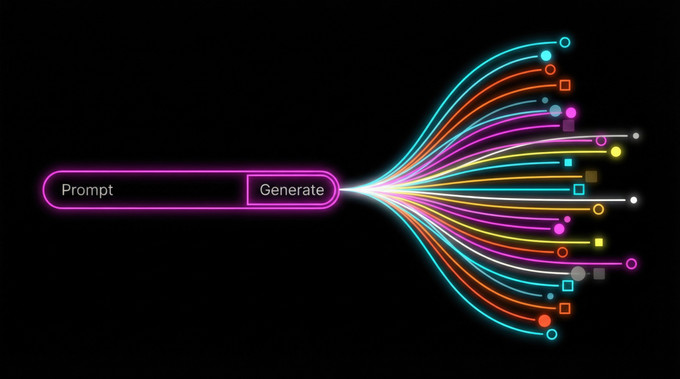
Generative AI Models
Examples: Text only Large Language Models (LLMs), image and audio generators, cross‑modal models (text ↔ image), multimodal models (text + image + audio + video)
- Built to generate new content (text, images, audio, and/or video)
- Trained on massive amounts of data (text, images, audio, and/or video)
- Uses pattern learning and prediction
Agentic AI
Examples: Task-oriented agents, tool using agents, planning agents, multi agent systems
- Built to plan and execute multi-step tasks, take actions, use tools, and adapt to new information
- Self-monitors and refines strategies with minimal human intervention
- Retains history and context to learn from earlier outcomes
- Typically built on top of LLMs or multimodal models, with added capabilities for tool use, planning, and memory (e.g., how to connect with and use software applications and browsers, how to run code etc.) to perform more complex and multi-step tasks
The Difference
Traditional AI (analytic AI and predictive AI)
Traditional AI (analytic AI and predictive AI) is based on a statistical model or set of rules designed by experts for a specific task. It applies the predefined rules or logic to input data and then makes predictions or identifies trends, patterns, and relationships within the given dataset to inform users’ decisions. Traditional AI tools are typically built for specific tasks such as classification, detection, prediction, system optimization, diagnostic decision-making, or image recognition, giving us widely varied applications such as email spam detection, stock market prediction, medical image classification, inventory management, university timetabling and enrollment forecasting and many more. Traditional AI also includes pre-GenAI Machine Learning and Natural Language Processing models, which enabled earlier versions of grammar and spell checkers, for example.
Unlike traditional AI technology, GenAI applications create content using the vast data they are trained on. Currently, GenAI models fall into one of the following categories: large anguage models (LLMs), image generators, audio generators, video generators, and multimodal models.
Large Language Models (LLMs)
Image, Audio & Video Generators
As the name suggests, Image Generators create new images, artistic-style visual content, and illustrations and modify existing images. DALL·E and Midjourney are two examples. Audio Generators, such as Suno, ElevenLabs and AudioLM, can create music, sound effects, and synthetic voices. Video Generators can produce animations, short clips, and cinematic sequences. They are trained on large datasets of existing real videos and/or simulated videos, images (photos and illustrations), and paired video/image-text datasets (captions, transcripts, and descriptions). Google Veo, Meta Emu Video, OpenAI Sora, Runway Gen are a current sample of Video Generators. Multimodal GenAI Models can process and generate input/output in multiple modalities (text, images, audio, and video) simultaneously. For instance, they can generate an image from a text description, convert text into audio or audio into text, describe a video, and integrate several modalities of input (text, image, and audio) into a single output. Multimodal Models are powered by massive datasets of image-text pairs, video-text pairs, audio-text pairs and datasets comprising multiple formats. Some examples are Google Gemini, OpenAI GPT, Meta LLaMA , and Anthropic Claude.
Agentic AI
The latest emerging AI systems are known as Agentic AI. Agentic AI combines reasoning, planning, and tool use (such as, software applications and databases) to perform complex, multi-step tasks with a great degree of autonomy. Thus, unlike LLM-based GenAI or multimodal GenAI, Agentic AI systems function with minimal human intervention in achieving the pre-determined goals they are designed for as opposed to reacting to prompts; they can adapt to new information and adjust their course of action accordingly. They can retain history and context and thus learn from earlier results. Current applications of Agentic AI across sectors include customer service and support; automated employee onboarding; expense report generation; workflow automation (e.g., payroll); task management (e.g., scheduling meetings and updating calendars); and academic literature scans.