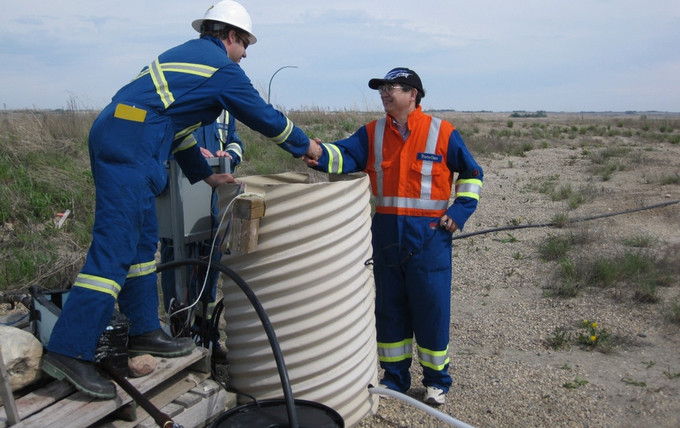
Imagine a typical winter day at any oil field in rural Saskatchewan. Scattered across the snow-covered landscape are hundreds of wellheads. For decades, these sites have presented a “Prairie Paradox,” a two-headed environmental and economic headache.
First, they produce fugitive gas, mainly methane, which is 25 times more potent than carbon dioxide. Since it is difficult and costly to recover from scattered sites, this greenhouse gas is often vented or flared, wasting energy and contributing to climate change. Second, the oil recovery process creates large volumes of “produced water,” non-potable water containing high levels of dissolved mineral salts, organic compounds, and heavy metals, which requires significant energy to treat before it can be safely reinjected or discharged.
We are engineers; we deal with problems in the country, province, and city. We solve problems and create new tools for solving them. — Prof. Gordon Huang, University Distinguished Professor, Faculty of Engineering and Applied Science, University of Regina
For years, the industry treated these as separate, costly problems. But within the Faculty of Engineering and Applied Science at the University of Regina, Professor Gordon Huang and his team saw a hidden synergy.
The “Aha!” moment on wheels
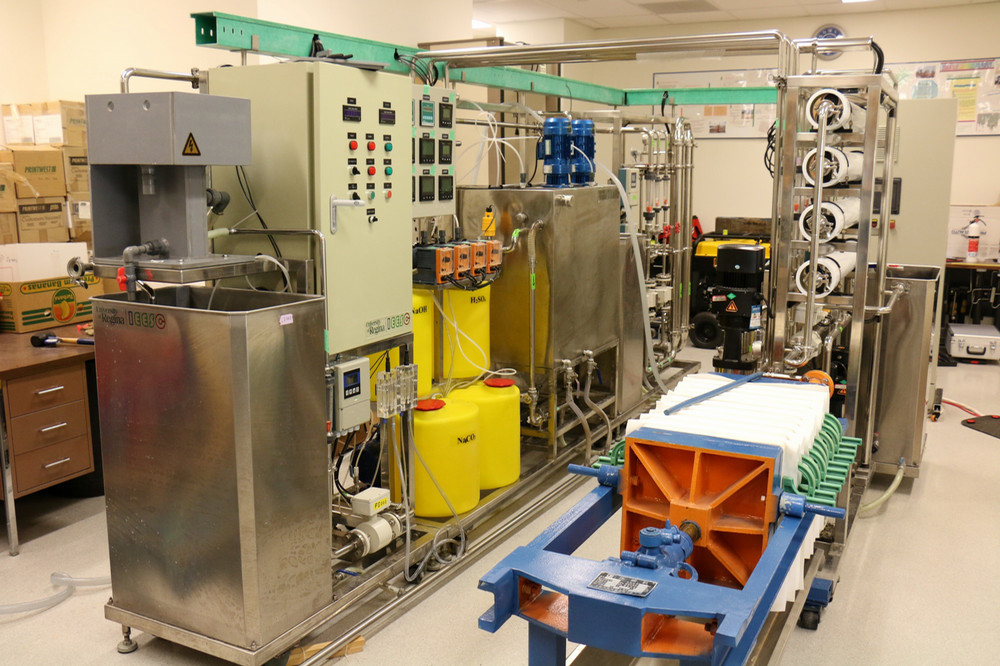
Inside the innovation: The heart of the Mobile Modularized System (MMS). This unit uses advanced electrocoagulation and membranes to turn toxic oilfield produced wastewater into safe effluent, powered by waste methane. Photo Credit: Prof. Gordon Huang
Dr. Huang, a distinguished university professor and former Tier 1 Canada Research Chair, believes that engineering exists to address community issues. When observing the scattered wellheads, he recognized that the waste from one problem could serve as the solution for another.
“I have to admit that it wasn't really a single ‘aha!’ moment, but more of a growing realization,” Huang recalls. “We saw all this produced and fugitive gas at wellheads, and right there at the same sites, was the constant need to treat produced water, which demands a lot of energy. The idea… just clicked. It was about seeing two separate challenges and realizing their solutions were intrinsically linked.”
The solution is the Mobile Modularized System (MMS).
Think of it as a roving recycling plant. Housed on a trailer nimble enough to be pulled by a pickup truck, the system drives directly to a wellhead. It captures the fugitive methane and, instead of letting it flare off, uses it as free fuel for an on-board power generator. That electricity then powers a sophisticated water treatment module right on the trailer, cleaning the produced wastewater on-site.
It is a "win-win" solution that reduces emissions and operational costs simultaneously, turning a dual waste problem into a self-sustaining operation.
Solving problems, not just studying them
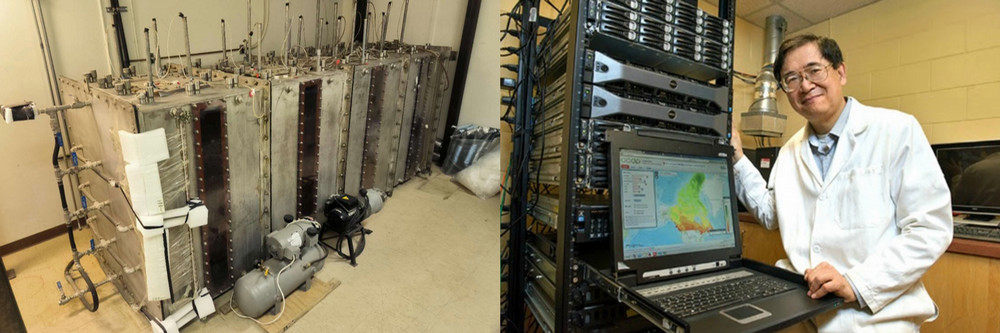
From Soil to Sky: Whether visualizing invisible pollutants in the nation’s first groundwater simulation pilot (left) or forecasting the next century of weather using high-performance supercomputing (right), Dr. Gordon Huang is engineering a safer future on every front. This is how the U of R turns complex data into real-world protection. Photo Credit: Prof. Gordon Huang
This practical, high-impact approach defines the philosophy of the Faculty of Engineering and Applied Science at the U of R.
“We are engineers; we deal with problems in the country, province, and city,” Huang explains. “We solve problems and create new tools for solving them. Scientists study fundamentals, but engineers solve problems.”
The MMS project has attracted over $1 million in funding from partners, including the Clean Resource Innovation Network (CRIN), the Petroleum Technology Research Centre (PTRC), and Mitacs. It is part of a substantial research portfolio in which Huang has secured support for more than 200 projects, including a number of NSERC Strategic/Alliance Grants.
His team’s innovations extend well beyond the oil patch. At the Education Building, they operate the nation’s first groundwater simulation pilot tank, a large 4-metre system that enables researchers to physically visualize how pollutants move through soil layers, pinpoint contamination hotspots, and test remediation methods with high precision. Additionally, the team built the Climate Change Data Portal (CCDP), a freely accessible digital platform that provides high-resolution climate projections down to at high spatial and temporal resolutions for entire Canada and simulates more than 40 parameters, including temperature, precipitation, evaporation, and wind speed, on an hourly basis over the next century. The portal empowers decision-makers to design resilient infrastructure capable of withstanding future climatic and environmental shifts.
A new generation of innovators
This culture of rigorous problem-solving is attracting Canada’s brightest rising stars to the U of R. Dr. Shuang Nie, a recent recipient of the prestigious NSERC Postdoctoral Fellowship, co-supervised by Drs. Gordon Huang and Philip Choi, joined U of R to bridge the gap between electrical engineering and environmental modelling. For Dr. Nie, the U of R offers a unique environment where emerging researchers are empowered to lead.
Coming from a background in high-power wireless transfer systems for electric vehicles (EVs), Dr. Nie wanted to expand his expertise from hardware to large-scale systems modeling.
“I realized that nowadays, the most effective way to do research is to understand both the software and hardware aspects," Nie says. “So, I approached Drs. Huang and Choi, who are experts in modelling, and I was eager to learn some of their approaches that could be applied to my field. Professors Huang and Choi encourage us to look beyond the lab bench,” says Dr. Nie. “They challenge us to consider how our research interacts with the real world. It’s not just about publishing papers; it’s about developing technologies that industry can actually use to become more sustainable.”
The mentorship ripple effect
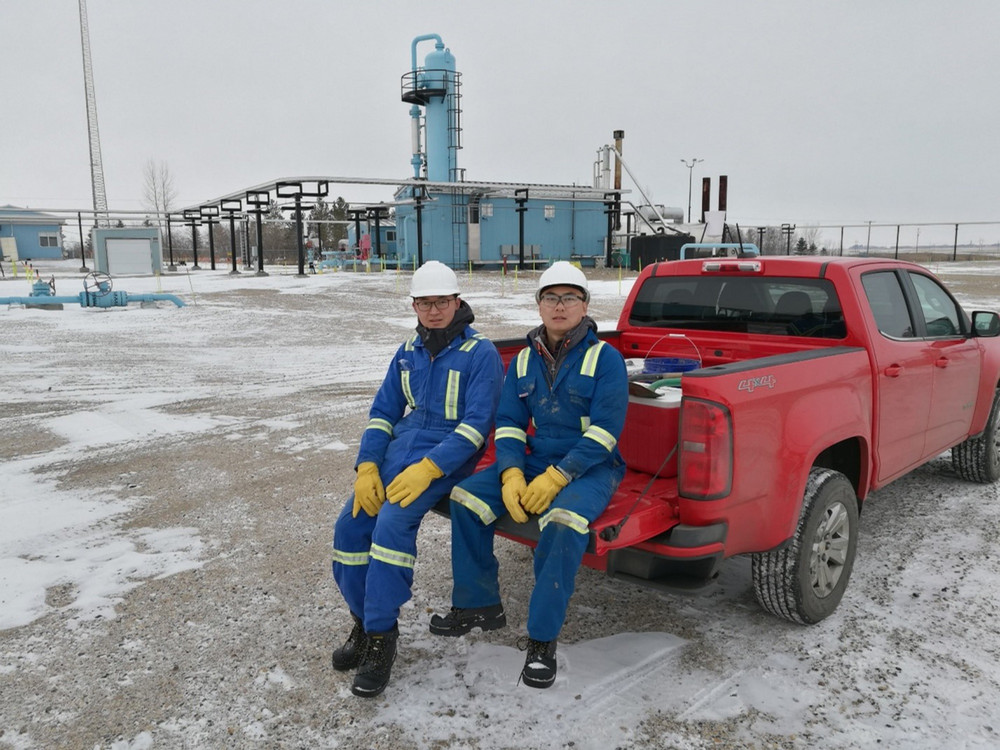
Engineering in the wild: Graduate student researcher on-site in rural Saskatchewan, proving that the best environmental solutions are built in the field, not just the classroom. Photo Credit: Prof. Gordon Huang
Inside the lab, the collaboration between mentor and mentee is driving new solutions for the future of transportation in Saskatchewan. Recognizing that range anxiety remains a major obstacle for EV drivers, Dr. Nie is applying modeling techniques to solve a critical cold-weather challenge: ensuring EVs remain reliable even when the temperature plummets.
Using real-world data from the City of Regina, Nie is assessing the risks of EV charging during harsh winters. His work aims to optimize routing strategies that will ensure drivers can always reach a charging station safely, eliminating the risk of a dead battery and the dangerous prospect of being stranded in sub-zero temperatures.
This research is shaped by Huang’s mentorship style, which pushes students to look beyond the technical details to the core purpose of their work.
“He focuses heavily on the motivation, the groundwork you’re building your research on,” says Nie, describing the rigorous weekly meetings where Huang pushes students to define the ‘why’ behind their models. “He dives deep into the research gaps to ensure the work is necessary. He is constantly focused on whether you are digging out real findings that are important to readers and our regular residents.”
Engineering a legacy
For Huang, the ultimate goal is to equip the next generation with the mindset to tackle the evolving environmental challenges of the next decade, particularly the decarbonization of the energy sector.
“I want them to genuinely grasp and embody the idea of 'engineering for impact,” Huang says. “It's not just about theoretical knowledge; it's about applying that knowledge to address real, urgent societal and environmental issues. I hope they learn to look beyond traditional boundaries and consider how different systems can be connected,” Huang adds. “I want them to become the next generation of leaders who will steer us toward a truly sustainable future.”
Ready to engineer real-world solutions? Explore the innovative programs and research opportunities at the Faculty of Engineering and Applied Science at U of R.
Whether it's a mobile trailer that uses waste gas to clean water in rural Saskatchewan or an advanced model that guarantees an EV can reach home during a blizzard, the U of R’s engineers are creating tools for a sustainable, resilient future. For oil companies, this results in lower operational costs and a stronger social license to operate. For the province, it means significantly reducing greenhouse gas emissions and enhancing water stewardship. For students and fellows like Dr. Nie, it provides the skills needed to lead Canada’s shift toward a greener economy.
Banner Image - The mentorship ripple effect: student researchers working shoulder-to-shoulder with Prof. Huang, gaining the hands-on skills required to lead Canada’s transition to a sustainable energy future. Photo Credit: Prof. Gordon Huang
About the University of Regina
At the University of Regina, we believe the best way to learn is through access to world-class professors, research, and experiential learning. We are committed to the health and well-being of our more than 16,600 students and support a dynamic research community focused on evidence-based solutions to today’s most pressing challenges. Located on Treaties 4 and 6—the territories of the nêhiyawak, Anihšināpēk, Dakota, Lakota, and Nakoda peoples, and the homeland of the Michif/Métis nation —we honour our ongoing relationships with Indigenous communities and remain committed to the path of reconciliation. Our vibrant alumni community is more than 95,000 strong and enriching communities in Saskatchewan and around the globe.
Let’s go far, together.