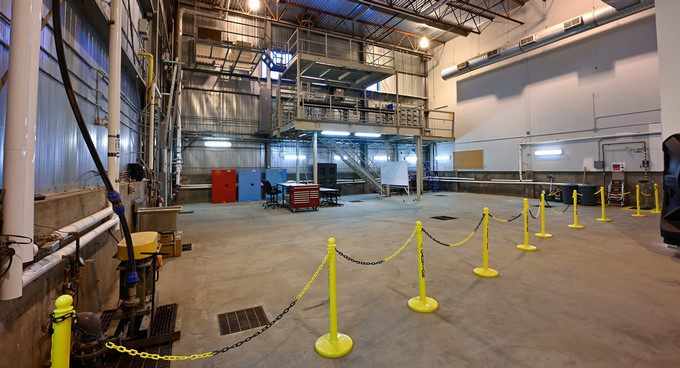
At the University of Regina, researchers are laying the groundwork for the next generation of nuclear energy innovation. A large new facility is being prepared to house two test loops that will simulate the conditions inside a nuclear reactor, with the first expected to begin operating in early 2027 and a second, larger loop following in 2028.
The researchers who will use the test loops are already hard at work. Dr. Arthur Situm, assistant professor in Energy Systems Engineering and Tier 2 Canada Research Chair in Small Modular Reactor Safety and Licensing, often explains nuclear reactors with a straightforward analogy that anyone can follow.
The idea is to provide knowledge for Canada to learn and get experience with some of these fundamental systems. — Dr. Arthur Situm, Assistant Professor, Energy Systems Engineering, and Canada Research Chair in Small Modular Reactor Safety and Licensing, University of Regina
“Fundamentally, what we’re doing is boiling water,” he says. “These things are essentially giant water boilers that we use to spin a turbine to power electricity.”
In other words, it’s a kettle on a stove, on a far larger scale.
Bringing reactor conditions into the lab
Situm’s research group in the Faculty of Engineering and Applied Science studies the safety of the fuels and materials used in small modular reactors (SMRs), advanced nuclear reactors designed to be built in modules. Their work will play a key role in the future Small Modular Reactor Safety, Licensing and Testing (SMR-SLT) Centre, where researchers will investigate the performance and safety of reactor components under realistic operating conditions.
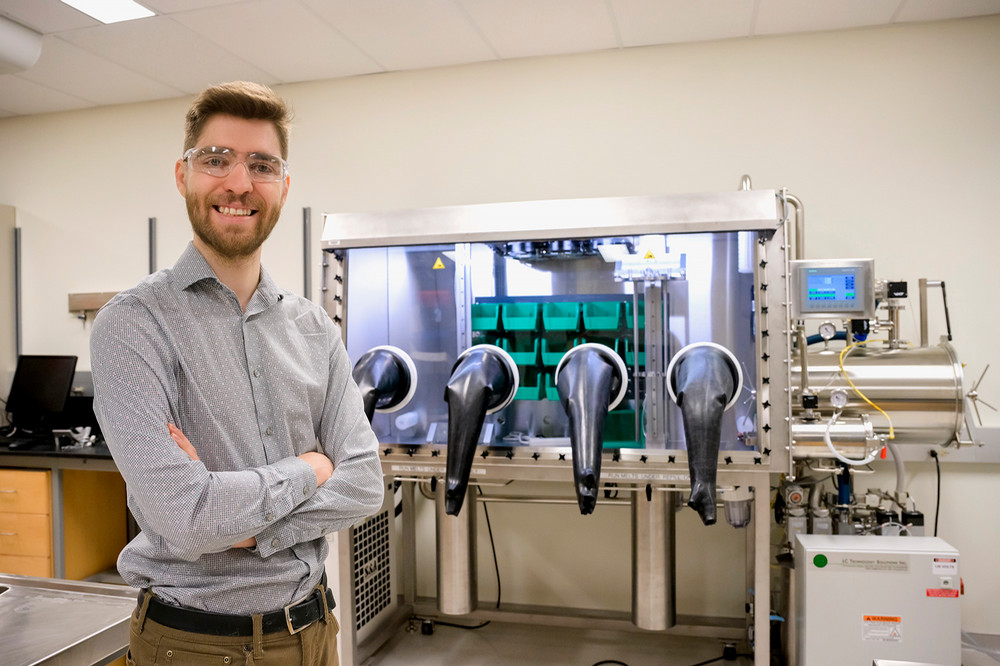
Materials first. Situm’s research group studies how nuclear fuel and reactor materials behave, using equipment such as this glovebox for research on corrosion in molten salts. Photo Credit: University Communications and Marketing
The group’s work spans accident-resistant fuels, the long-term behaviour of new reactor fuels in underground storage, and corrosion in molten salts, a coolant used in some advanced reactor designs. Much of that research takes place in the University’s dedicated radiological laboratory, which Situm describes as a “kind of a hidden gem that the university has access to.”
The U of R’s Small Modular Reactor Safety, Licensing and Testing (SMR-SLT) Centre, announced in January 2026, will build on that foundation.
The centre and its two test loops will support both research and hands-on student learning. Although they replicate conditions found inside a nuclear reactor, neither uses uranium. Both are heated electrically, providing a safe and flexible environment for testing and experimentation.
The first loop, the Component Corrosion Test Loop, is expected to begin operating in early 2027. It will test whether materials and components, including valves and the metal tubes that hold nuclear fuel, can withstand reactor conditions.
The second, larger loop, known as the Natural Circulation Flow Loop, is expected to begin operating in 2028 and will demonstrate how a reactor can remove heat and remain cool through natural circulation, without relying on pumps.
Situm says its emergency cooling system looks “very similar to the radiators you might have in your home if you have old-style baseboard heating.”
For Situm, the value of the test loops is practical: understanding how a component or a cooling system will behave before it is ever placed inside a reactor.
Beyond advancing reactor safety and performance, this work supports Saskatchewan’s long-term energy strategy. In a provincial plan released in September 2026, the province set a goal of developing at least 2,600 megawatts of nuclear power capacity by 2050.
Partnerships power the new nuclear test centre
SaskPower, Saskatchewan’s provincial utility provider, is building its own nuclear engineering capacity. As the centre takes shape, the University consults regularly with SaskPower, which recently participated in a design workshop for the Natural Circulation Flow Loop.
Canadian Nuclear Laboratories (CNL), Canada’s national nuclear laboratory, is contributing a large portion of the centre’s design. Situm’s research group also collaborates with CNL on fuel fabrication.
The Global Institute for Energy, Minerals and Society (GIEMS), a partnership among the U of R, the University of Saskatchewan, and Saskatchewan Polytechnic, provides shared access to research facilities, including the test loops. Situm says GIEMS gives the province a “Team Saskatchewan presence” when engaging with partners beyond its borders.
Asked what it would take for Saskatchewan to become a nuclear research hub over the next decade, Situm points to a fully operational test centre, the recruitment of additional researchers through new research chairs, and continued collaboration through GIEMS. He also sees SaskPower’s progress as closely tied to the University’s own.
“SaskPower is the main proponent for these projects, and so their success is our success,” he says.
Graduate students take on Saskatchewan’s nuclear questions
Building a nuclear research hub requires more than facilities and equipment. It also requires the next generation of researchers.
Michael Palsich completed his undergraduate degree in Energy Systems Engineering at the U of R in April 2026 and stayed on to pursue a Master of Applied Science (MASc). His path into nuclear research began when Situm delivered a guest lecture in one of his introductory courses, sparking an interest that led Palsich to join Situm’s research group as a research assistant.
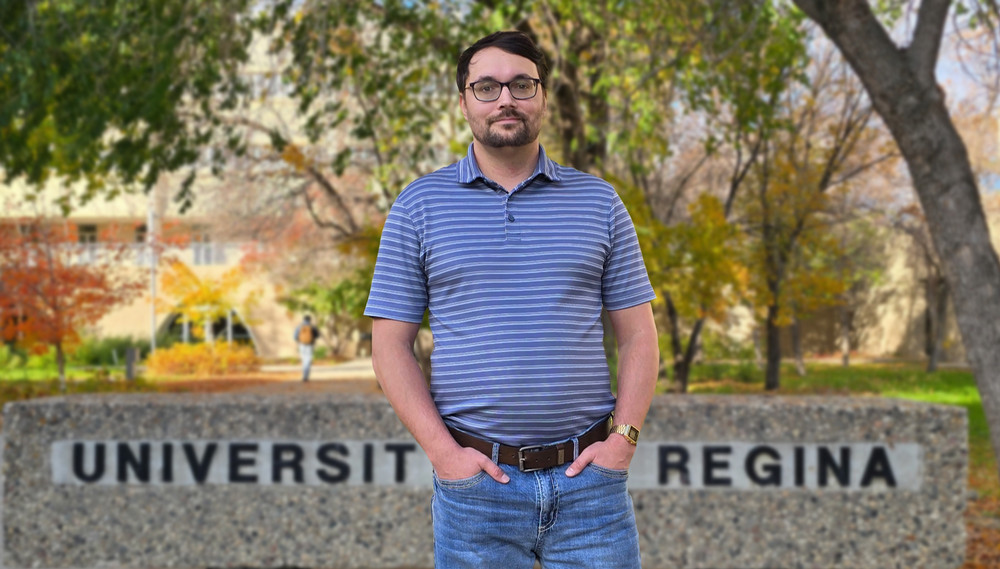
The student who stayed. After completing his undergraduate degree in Energy Systems Engineering, Palsich stayed at the U of R for a master’s, testing whether locally available valves can serve in nuclear plants. Photo Credit: University Communications and Marketing
Palsich uses computer simulations to evaluate part of a planned test loop’s design. His research examines whether valves already certified for use in other industries could be safely deployed in nuclear plants, a question that could help Saskatchewan companies enter the nuclear supply chain.
For Palsich, continuing his post-secondary journey at the U of R also meant staying close to home.
“I want to contribute to the future of nuclear energy in the province I call home,” Palsich says.
He has not ruled out staying even longer.
“I don’t have any immediate plans to pursue a doctorate, but who knows, Dr. Situm convinced me to stay for a master’s, so maybe he’ll do it again,” he says.
Christopher Hansen, a first-year MASc student in Energy Systems Engineering, took a different path, entering nuclear research from a mechanical engineering background. His project explores ways to make fuel for boiling water reactors safer and more economical.
Yet Hansen sees Saskatchewan’s nuclear future extending well beyond engineering.
“The capacity that we need to build in Saskatchewan is more than just engineering or the sciences. We need to build an entire ecosystem, and that means we need everybody from every walk of life,” Hansen says.
Preparing students for careers in nuclear energy
Students aren’t waiting for the test loops to begin learning about reactor systems. This fall, final-year students in the Faculty of Engineering and Applied Science’s Energy Systems Engineering program began using the new Nuclear Simulation Lab as part of their nuclear energy engineering course.
The lab features two software programs. The first, developed by the International Atomic Energy Agency (IAEA), simulates a large boiling water reactor, an established reactor design and larger counterpart to the small modular reactor now being built in Canada. Students can observe how safety systems, power output, and alarms interact under different operating conditions.
The second program, OpenMC, is a free, open-source simulation software that models the reactor's core, where fuel is located.
Situm says the lab is a major step toward preparing the skilled workforce Saskatchewan will need as its nuclear sector grows.
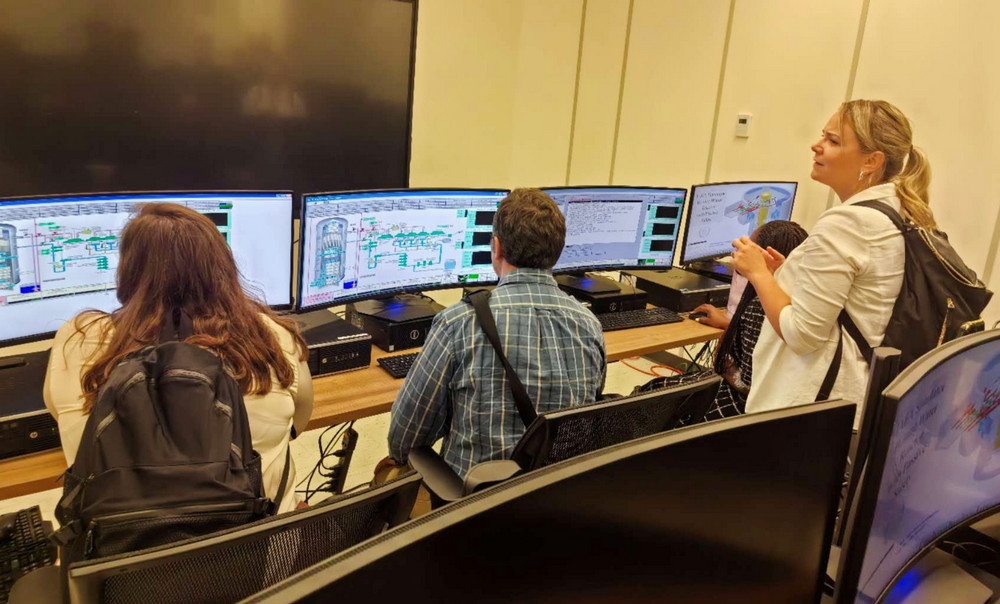
Hands on the controls. In the Nuclear Simulation Lab, Energy Systems Engineering students learn how a reactor’s safety systems, power output, and alarms respond to one another, long before the test loops arrive. Photo courtesy of Dr. Arthur Situm, assistant professor and Canada Research Chair (Tier 2) in Small Modular Reactor Safety and Licensing
“We’re the only post-secondary institution in the province that has established a simulation lab right now in terms of educating students,” Situm says.
For Situm, however, the simulation lab is just the beginning. The test centre will extend that learning beyond the classroom.
“The idea is to provide knowledge for Canada to learn and get experience with some of these fundamental systems,” he says.
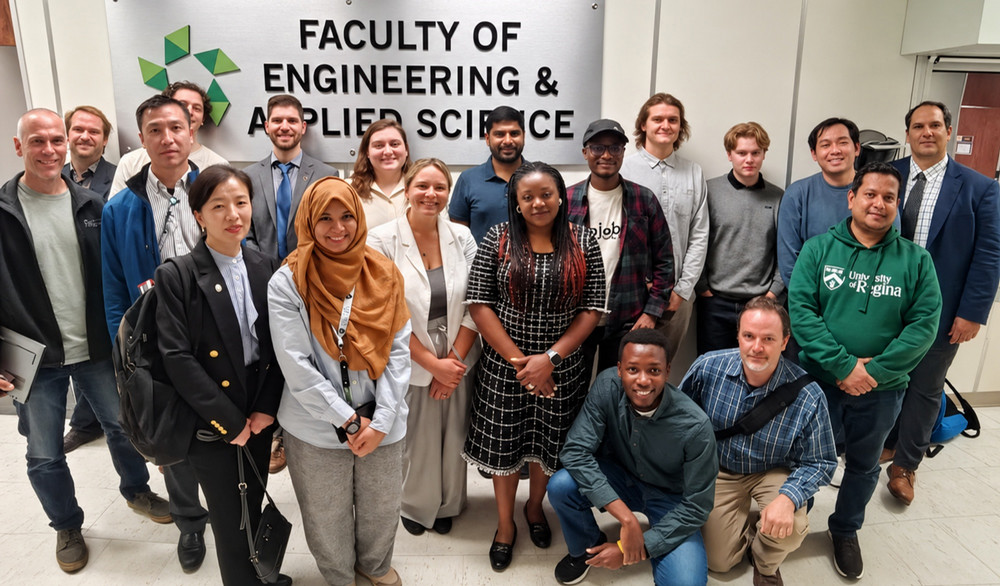
Learning on the simulators. Students, researchers, and guests involved in the Nuclear Simulation Lab gather for a photo. Final-year Energy Systems Engineering students now practise on the lab’s reactor simulation software. Photo courtesy of Dr. Arthur Situm, assistant professor and Canada Research Chair (Tier 2) in Small Modular Reactor Safety and Licensing
That experience opens doors to a range of career opportunities. Situm expects U of R graduates to join vendors, engineering firms, and utilities involved in designing, building, and operating nuclear energy systems.
The work also supports the University of Regina’s 2026–2035 strategic plan, Together, We Serve, by expanding research infrastructure through partnerships with SaskPower and CNL, sharing facilities with partner institutions through GIEMS, and by giving students hands-on experience before they enter the workforce.
Beyond research and training, Situm is committed to engaging openly with the public about nuclear energy.
“The one thing I try to emphasize is providing honest information about where problems might be, where certain hazards may be misunderstood, and where they genuinely exist and must be managed,” he says.
Help shape the future of energy. Explore research opportunities and degree programs in the Faculty of Engineering and Applied Science at the University of Regina.
For future engineers, his message is simple.
“There’s a lot happening in this sector, and there’s a lot of crossover between this sector and other conventional industrial sectors as well, and it’s an exciting time to be in the field,” he says.
By the time the first test loop begins operating in early 2027, the U of R will already have a community of researchers and students prepared to turn its potential into discovery.
Banner image: Ready for the loops. This space is being prepared for the test loops at the U of R’s Small Modular Reactor Safety, Licensing and Testing Centre, with the first expected to begin operating in early 2027. Photo Credit: University Communications and Marketing
About the University of Regina
At the University of Regina, we believe the best way to learn is through access to world-class professors, research, and experiential learning. We are committed to the health and well-being of our more than 16,400 students and support a dynamic research community focused on evidence-based solutions to today’s most pressing challenges. Located on Treaties 4 and 6—the territories of the nêhiyawak, Anihšināpēk, Dakota, Lakota, and Nakoda peoples, and the homeland of the Michif/Métis nation —we honour our ongoing relationships with Indigenous communities and remain committed to the path of reconciliation. Our vibrant alumni community is over 97,000 strong and enriching communities in Saskatchewan and around the globe.
Let’s go far, together.