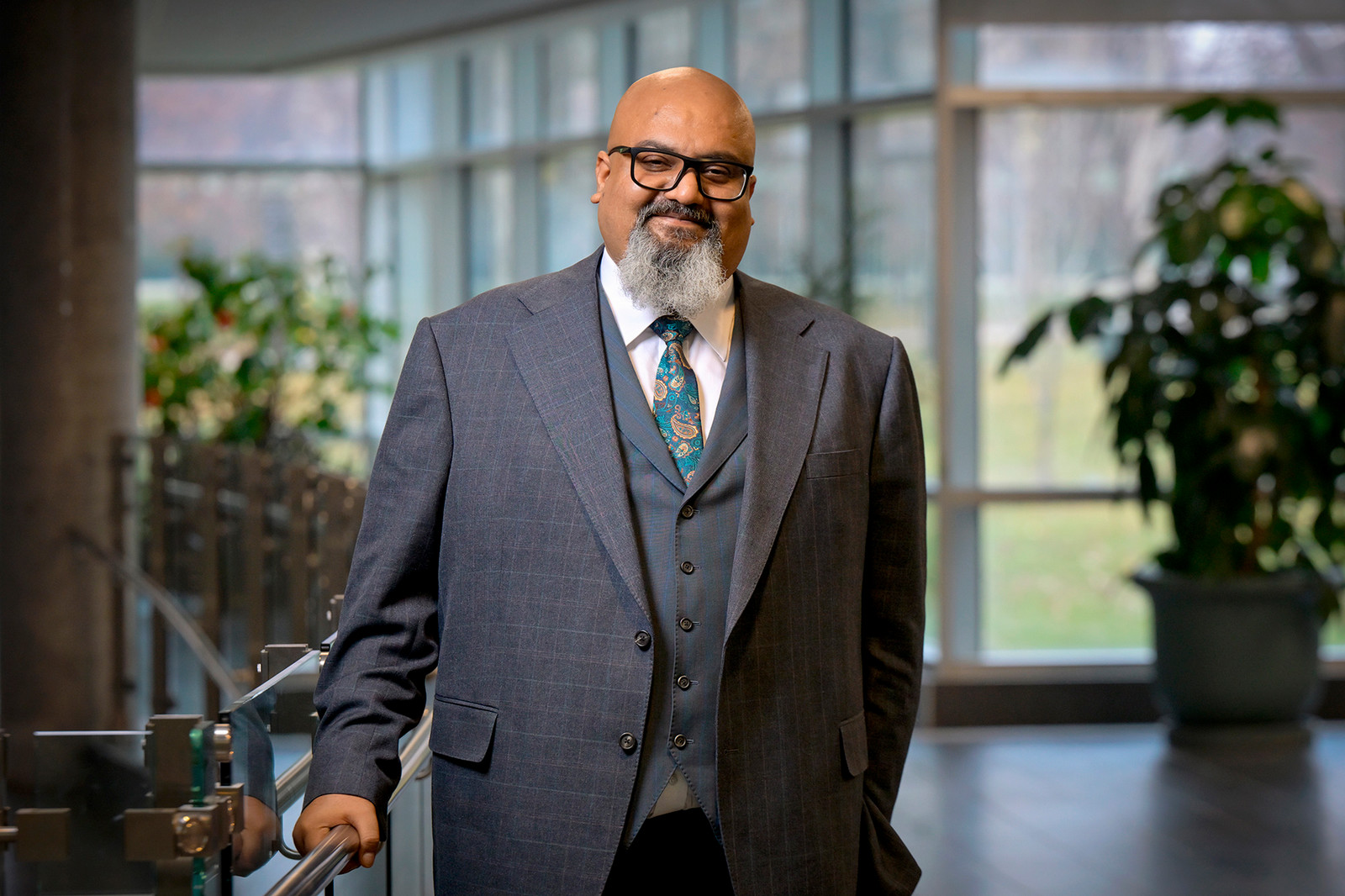
U of R Welcomes Leading AI Researcher Dr. Ajit Khosla
In early November, the University of Regina was pleased to welcome Dr. Ajit Khosla, the Eddie Goldenberg Research Chair of Canada in Real-World, AI Driven Turnkey Systems for Environmental Intelligence to the department of Electronic Systems Engineering in the Faculty of Engineering and Applied Science. Thanks to support from the federal government, Khosla will receive $8 million over eight years and will establish the Environmental Intelligence Hub (EIH) at the University of Regina.
Khosla's research program is inherently interdisciplinary, bridging materials science, device engineering, and systems integration. His current work focuses on advanced functional materials, novel interfaces, and micro- and nanofabricated chemical and biological sensors. Critically, he integrates artificial intelligence (AI) for advanced signal processing, pattern recognition, and intelligent decision-making, alongside quantum metrology to push the boundaries of ultra-high-precision measurement at the nanoscale and quantum limits. These innovations are embodied in swarm turnkey systems that address pressing real-world challenges—spanning healthcare diagnostics, environmental monitoring and restoration across diverse ecosystems, additive manufacturing, sustainable design and manufacturing, and clean-water purification—with the ultimate goal of improving global quality of life.
The Office of Research Service's recently sat down with Dr. Khosla to learn more about the impact of his research.
Q. Your research explores the use of AI-driven sensing technologies in agriculture. How do you envision these technologies transforming agricultural practices in Saskatchewan?
Lord Kelvin’s axiom that “if you cannot measure it, you cannot improve it” has long guided environmental science. Today, static, single-point measurement is possible, but synchronized multi-node sensing networks that deliver real-time environmental intelligence driven by artificial intelligence (AI) do not yet exist. This gap creates vast economic costs. Canadian agriculture loses $1.5 billion annually because subterranean pathogens are detected only after significant crop loss—part of a global crop loss crisis costing up to $31 billion for wheat alone. Agronomists are currently unable to continuously monitor soil respiration alongside critical indicators like temperature, moisture, heavy metals, and nitrogen, phosphorus, and potassium (NPK) levels. We transform this by harnessing quantum spillover effects in precisely engineered ultra-thin two-dimensional (2D) materials. Our quantum sensors/detectors achieve unprecedented parts-per-billion to parts-per-trillion sensitivity at room temperature—measuring the previously unmeasurable. Deployed as autonomous swarms, these AI-driven networks transform agriculture from reactive to predictive, allowing farmers to pinpoint metabolic precursors and treat only affected rows before crop death occurs.
Q. What are the biggest barriers or challenges to translating laboratory innovations into reliable, turnkey technologies that can be deployed in real-world environments, and how do you overcome them?
The biggest challenge is the “deployment gap”—taking a delicate invention that works perfectly in a clean lab and making it survive in harsh real world field conditions. A central driver of this is a technological blind spot: modern regulatory limits have outpaced detection capabilities. Over 375,000 Canadian workers face benzene exposure and 152,000 face formaldehyde exposure, while mining workers are routinely exposed to hazardous trace gases. Current state-of-the-art classical sensors cannot detect these gases at the levels required by health and safety regulations. Since what cannot be detected cannot be mitigated, toxic exposures continue to claim lives.
Traditionally, highly sensitive sensors require power-draining heaters to clean themselves, making continuous battery-powered monitoring impossible. We overcome this using quantum sensing detection, which resets instantly using almost no or minimal power. Furthermore, disaster zones, deep mines, and remote sites often lose GPS and cellular signals. We solve this by deploying smart “swarms” with built-in AI to navigate autonomously. Finally, we use advanced printing techniques to mass-produce these quantum networks cost-effectively.
Q. With the establishment of the Environmental Intelligence Hub (EIH) at the University of Regina, how do you envision the Hub supporting researchers from different disciplines?
This program directly fills a critical gap at the University of Regina and in Canada by building the country’s first end-to-end environmental intelligence capability—moving from isolated sensors to AI driven, multi node networks that translate real time data into actionable decisions. The Environmental Intelligence Hub (EIH) serve as a collaborative technology engine designed to shatter academic silos. By housing custom-made, atomic-resolution characterization equipment and realistic testbeds, the Hub will support an unprecedented convergence of disciplines.
Materials scientists, physicists, chemists, engineers, social scientists, and agronomists will collaborate to engineer sub-nanometre sensor defects, while computer scientists embed 5th-generation AI to decouple overlapping chemical signatures. Beyond STEM, the Hub actively integrates public health and policy. The World Health Organization estimated that chemical exposures claimed 4.9 million lives globally in 2004, while urban and household air pollution cause nearly 5 million premature deaths yearly. My expertise in quantum sensing and embedded AI unites these diverse researchers to synthesize raw data into the actionable intelligence needed to mitigate these vast human and economic costs.
Q. What advice would you offer early-career researchers interested in pursuing innovative research at the intersection of AI, agriculture, and environmental science?
My most important piece of advice is persistence: never give up. If your dreams and goals are backed by genuine hard work, nothing under the sun can stop you from achieving them. Never give up, and do not compare yourself with others—comparison simply does not work. Instead, strive for excellence and compete with yourself; shun ego and stay humble. And if you ever feel like giving up, I recommend reading the poem “If—” by Rudyard Kipling.
Scientifically speaking, cultivate a “T-shaped” mindset: develop deep vertical expertise in your core domain while building broad horizontal mastery across disciplines—including commercialization, policy, and Indigenous stewardship. In practice, do not settle for passive data collection; instead, bridge the entire Sense–Interpret–Act pipeline. Translate quantum sensing detection into field-ready, turnkey autonomous swarm systems that solve real-world crises in agriculture, industry, and the environment. Finally, ensure your engineering is ethically grounded and designed to protect the communities you serve—because real impact is built together.
Learn more about Dr. Khosla's research in Measuring the Unmeasurable.
About Dr. Ajit Khosla
Before joining the University of Regina, Dr. Khosla was a Distinguished Professor at Xidian University and at Yamagata University. He earned his Ph.D. in Microelectronics from the School of Engineering Science at Simon Fraser University (SFU), Canada, in 2012, where he received the Dean of Graduate Studies Convocation Medal as one of SFU’s most outstanding graduate students. He is an elected Fellow of several prestigious institutions and societies.
A prolific researcher, Khosla has published more than 200 refereed journal articles and 16 books, holds five U.S. patents, and has an H-index of 60 with more than 14,250 citations. He served as Founding Editor-in-Chief of ECS Sensors Plus—ECS’s first gold open-access journal (2022–2026)—and as an Editor for the ECS Journal Family (2015–2024). He has organized more than 50 conferences, mini-colloquia, and workshops in collaboration with IEEE, ECS, ACS, and IOP, and has held editorial roles with IOP Nanotechnology and Wiley-IET Nanobiotechnology. His honors include the ECS Sensor Division Outstanding Achievement Award, and he has been listed among the top 2 per cent most-cited researchers by the Stanford–Elsevier ranking for five consecutive years (2021–2026).
Article republished with permission from the University of Regina's Office of Research Services (Research Connect Newsletter, November 2026).
Banner image: University of Regina Photography