
Community,
Research,
Campus Life,
Teaching & Learning
Canadian agriculture loses billions of dollars each year when organisms that kill crops are detected only after the plants die. In industry, chemical exposures claim millions of lives around the world. In mining, workers are routinely exposed to hazardous trace gases, such as formaldehyde and carbon monoxide, that go undetected because regulatory safety limits are sometimes below conventional sensors’ detection levels.
These issues aren’t from a lack of data, but rather a lack of real-time intelligence. If the right people knew what was happening, when it was happening, and what action was needed, many of these issues could be mitigated.
This is not just a university, it is a place where community, innovation, and purpose converge. — Dr. Ajit Khosla
This gap comes with an enormous human and economic cost. But the gap can be closed by using synchronized sensor networks that monitor the environment and turn raw data into solutions.
Dr. Ajit Khosla has received the Eddie Goldenberg Research Chair of Canada in Real-World AI Driven Turnkey Systems for Environmental Intelligence. Khosla will receive $8 million over eight years and will establish the Environmental Intelligence Hub (EIH) at the University of Regina.
“This is a deeply moving and proud moment for me,” says Khosla. “To be named an Eddie Goldenberg Research Chair is not merely a professional milestone. It is a profound validation of a vision I have carried for years: that we can build AI Driven Turnkey Systems to measure the unmeasurable and safeguard the land we farm, the water we drink, and the air we breathe.”
Khosla says the goal of his research program is to engineer ready-to-use sensor networks that detect trace contaminants in real time, synthesizing raw data into useable information. Khosla, who will be joining the University of Regina as a professor of electronic systems engineering in the Faculty of Engineering and Applied Science, is currently a distinguished professor at Xidian University, School of Advanced Materials and Nanotechnology in China and at Yamagata University in the Department of Mechanical Systems Engineering in Japan.
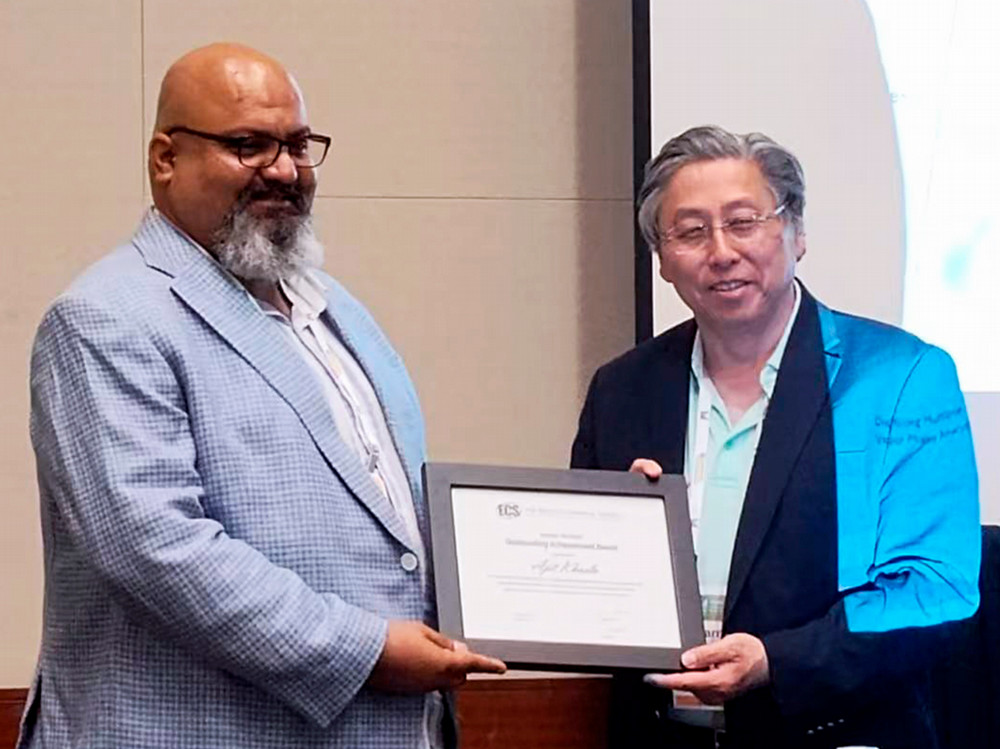
Dr. Ajit Khosla being awarded the Electrochemical Society Sensor Division Outstanding Achievement Award by Professor Larry Nanagahara from Johns Hopkins University for his outstanding contributions to AI-Driven Turnkey Systems. Photo credit: Ajit Khosla
By using advanced materials, microsystems engineering, and artificial intelligence he will create systems with three core functions:
“My sense-interpret-act approach will sense by using real-time detection of pollutants using robust sensor arrays. It will interpret using AI to transform data into predictive insights. It will act by integrating sensing with automated processes for resource capture and recovery,” says Khosla, who will arrive to the U of R in mid-October.
He says the "sense-interpret-act" pipeline will drive improvements across agritech and industrial safety.
To address technology shortcomings, classical sensors will be replaced with ultra-thin two-dimensional materials. He will then boost their sensitivity to parts-per-billion levels, an amplification that allows a sensor or detector to pick up on minute chemical traces that normal instruments would miss.
“We will also build fifth-generation AI into sensors to autonomously correct errors and predict hazards,” says Khosla, who will establish a Governing Council for the EIH, which will include industry and Indigenous representatives, to ensure research is ethically sound, culturally grounded, and commercially viable.
Khosla says the EIH will bridge the deployment gap between laboratory breakthroughs and field-ready technology. “By providing the right tools, this research program will safeguard worker health, enhance agricultural yields, and establish Canada as a global leader in the transition toward a sustainable, intelligence-driven, bio-economy.”
A remarkable commitment to research
Dr. Chris Yost, Vice-President (Research) at the University of Regina, says the federal government has shown visionary leadership in creating this Chairs research program and is thrilled to welcome Dr. Khosla to the University of Regina’s research community.
“Thanks to the federal government for creating an important program that helps ensure Canada’s place as a research-intensive country, that brings innovative and impactful research to the world,” says Yost. “As part of this significant program, we are proud to have recruited Dr. Khosla, a top international research talent. His work will strengthen our collaborations and connections with Saskatchewan’s agriculture and industry sectors, while creating solutions that can help keep people safer while also bolstering our local and national economies.”
Khosla says he couldn't be more excited to join the University of Regina community.
“This is not just a university, it is a place where community, innovation, and purpose converge. The University of Regina has demonstrated a remarkable commitment to research that addresses real-world problems: protecting livestock and improving water quality, detecting pathogens and supporting farmers, tracking atmospheric contaminants and developing precision agriculture technologies. This is an institution that understands a simple truth: the best science is science done with and for the community.”
In total, the federal government announced $504 million over eight years to support 64 Research Chairs in the programs first intake. The second intake will be announced in the coming months.
Banner image: Dr. Ajit Khosla at his desk. Photo credit: Ajit Khosla
About the University of Regina
At the University of Regina, we believe the best way to learn is through access to world-class professors, research, and experiential learning. We are committed to the health and well-being of our more than 16,600 students and support a dynamic research community focused on evidence-based solutions to today’s most pressing challenges. Located on Treaties 4 and 6—the territories of the nêhiyawak, Anihšināpēk, Dakota, Lakota, and Nakoda peoples, and the homeland of the Michif/Métis nation —we honour our ongoing relationships with Indigenous communities and remain committed to the path of reconciliation. Our vibrant alumni community is over 97,000 strong and enriching communities in Saskatchewan and around the globe.
Let’s go far, together.
Related Posts
Community,
Sustainability,
Research
From Runway to Landfill: Fashion Students Reshape Waste Research at the U of R
Teaching & Learning,
Research,
Community