Sustainability,
Campus Life,
Community
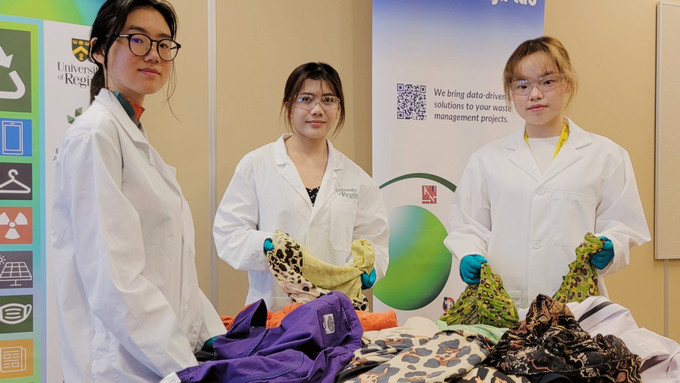
Three students in white lab coats and blue nitrile gloves stand over a table heaped with donated clothing in a University of Regina lab. They are not designing anything. They are grading it, turning each garment over in their hands, logging fabric composition, noting stains and tears, then assigning quality scores from A to E.
This score determines the garment’s next destination, separating high-quality items bound for resale from those requiring repair, recycling, or disposal.
All three students study fashion at The Hong Kong Polytechnic University and joined the U of R this summer as Mitacs Globalink interns. They are conducting research in the Waste Management System Design (WMSD) Lab under the supervision of Dr. Kelvin Tsun Wai Ng, Canada Research Chair (Tier 1) in Environmental Sustainability.
For me, fashion should not end at a runway, at a store, at a wardrobe. It should be studied across its whole life cycle. I hope my work can help build a future where fashion is not only beautiful, but also responsible, measurable, and circular. — Ashlee Pui Shuen Lee, Mitacs Globalink intern, Waste Management System Design lab, University of Regina
A design student starts asking a different question
Ashlee Pui Shuen Lee, one of the three interns, specializes in activewear and intimate apparel. She usually focuses on silhouette, fabric, and colour, but the internship prompted her to consider what happens when garments are no longer worn.
The answer lies in places most designers never look. In the studio scrap bins, for instance.
“When we draft patterns and cut fabric, leftover scraps often end up in the rubbish bin,” she says. “It’s not just fabric—trimmings like zippers and buttons usually can’t be recycled because they’re mixed with other textile waste.”
“Most of the garments we wear today are difficult to recycle, particularly because of materials like spandex that make clothes stretchy,” Lee explains. “Activewear often has special coatings, such as GORE-TEX for hiking clothes, to make them more water-repellent and breathable. These features make recycling even more challenging.”
Dr. Ng notes that this is a relatively new problem.
“Ten years ago, concerns about fashion waste were minimal because most materials were organic,” Ng says. “Back then, garments were primarily cotton—sent to landfills, they would simply biodegrade without issue.”
The rise of fast fashion has changed the landscape. Today, recycling a post-consumer garment costs about $10 a piece, more than the garment is worth, causing landfills around the world to accumulate large amounts of inexpensive, synthetic clothing.
For Lee, the motivation comes from confronting a reality that many designers overlook: while the industry focuses on creating beautiful garments, every finished piece leaves a mountain of textile waste behind.
"For me, fashion should not end at a runway, at a store, at a wardrobe. It should be studied across its whole life cycle. I hope my work can help build a future where fashion is not only beautiful, but also responsible, measurable, and circular," Lee says.
The assumption that doesn’t hold up
It’s often assumed that expensive clothing lasts longer, leading to less waste in wealthier fashion markets. To test this, Lee is analyzing Eurostat datasets and categorizing European Union countries by their luxury and fast-fashion market profiles.
“Based on our stereotypes, we may think that countries with higher Gross Domestic Product (GDP) have more luxury brands, and that’s why they’re more sustainable and more circular,” Lee says. “But our findings show otherwise. Countries with more luxury brands actually produce more waste—though they may manage it better through stronger infrastructure or by exporting it.”
The implication is that a high-consumption market can look cleaner on paper without generating less waste. Better infrastructure and waste exporting mask the volume.
While Lee studies market patterns, fellow intern Yiling Liu is building a composite index, a single scoring tool, to evaluate circular fashion performance across the European Union countries.
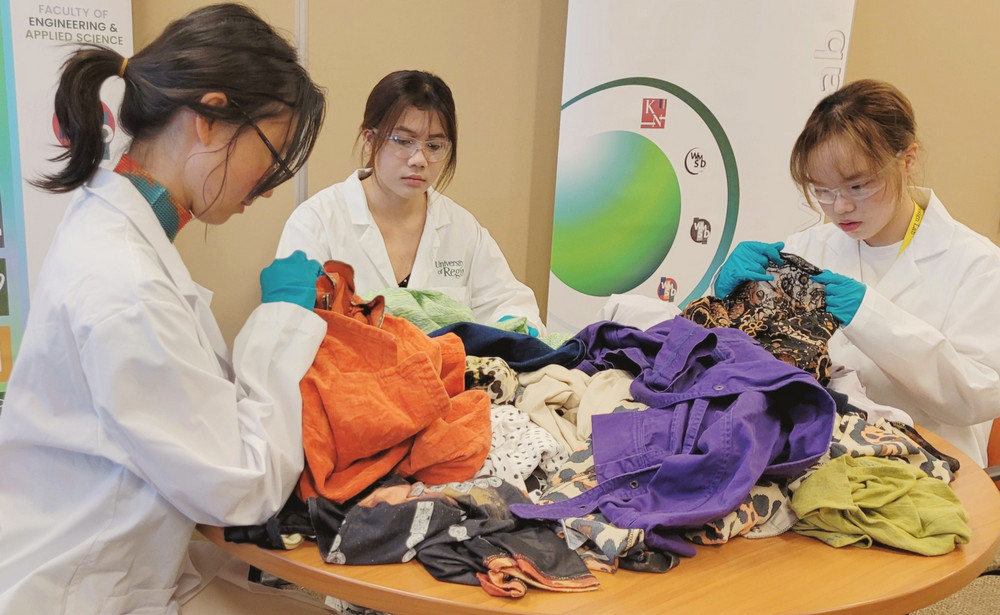
Bringing a designer’s eye to waste engineering, three fashion students from The Hong Kong Polytechnic University spent their summer at the U of R. Photo Credit: Dr. Kelvin Tsun Wai Ng
“My analysis follows two paths,” Liu explains. “The first is linear, meaning fabric moves from production to disposal, ending up in landfill or incineration. The second is circular: leftover fabric is reused, either through second-hand thrift stores or upcycling.”
The policy implication is that governments need tailored approaches rather than universal regulations, because a policy built for one market will not fit another.
Can a machine grade a shirt as well as a person?
Sheryl Jovana Sianipar brings the question to Saskatchewan. She is evaluating operations at Mennonite Central Committee (MCC) thrift stores. MCC receives thousands of donated garments every year, but manual sorting creates a slow, inconsistent bottleneck.
Sianipar is testing whether a vision language model can do part of that work.
“The model looks at a photo of a garment and extracts key details, garment type, brand, fabric composition, and visible defects like stains or tears, then assigns a quality grade from A to E,” Sianipar says.
Early findings from her analysis show that higher-quality garments are predictably directed toward resale, while garments with more severe defects shift toward repair, recycling, or disposal. She expects complete results by early September 2026.
The work also supports discovery and innovation, two strategic priorities from the University of Regina’s 2026–2035 strategic plan, Together, We Serve, by bridging unexpected disciplines to solve modern waste challenges and testing how artificial intelligence can create more sustainable supply chains for local charities.
Undergraduates leading real projects are central to the laboratory.
Turn curiosity into impact. Explore research and degree programs in the Faculty of Engineering and Applied Science at the University of Regina.
"I try not to impose my academic agenda on my students," Ng says. "My philosophy is that I provide a project to them, and I encourage them to take ownership of their project. And this is exactly why, when they talk about it, you can see that they really invest the time and effort."
The interns’ findings are expected before the summer ends, but the questions they brought to the laboratory will outlast their stay.
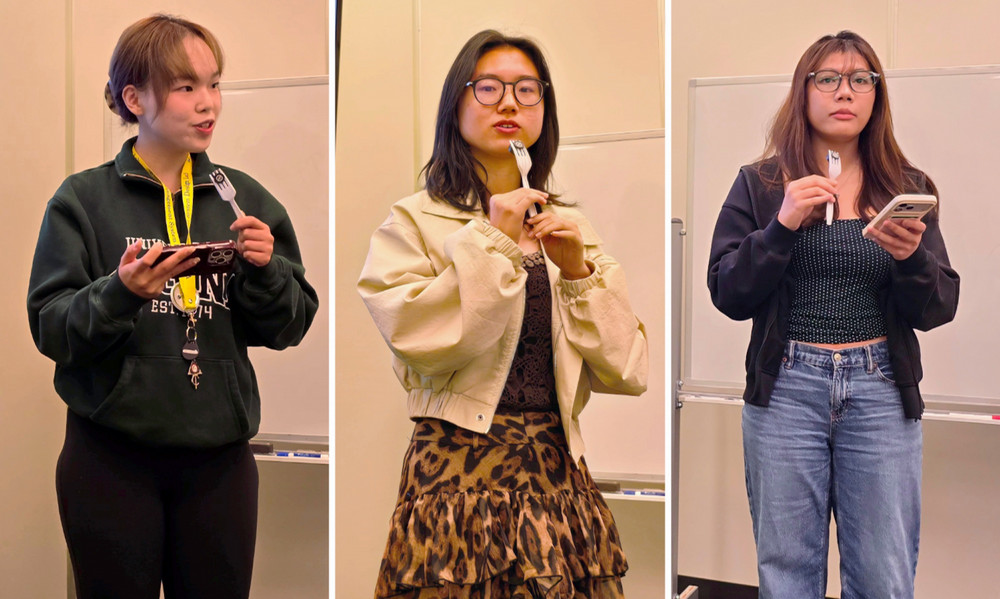
Banner image: From left, Yiling Liu, Sheryl Jovana Sianipar, and Ashlee Pui Shuen Lee, the three Hong Kong Polytechnic University interns whose research is bringing fashion into a waste engineering laboratory. Photo Credit: Dr Kelvin Tsun Wai Ng
About the University of Regina
At the University of Regina, we believe the best way to learn is through access to world-class professors, research, and experiential learning. We are committed to the health and well-being of our more than 16,600 students and support a dynamic research community focused on evidence-based solutions to today’s most pressing challenges. Located on Treaties 4 and 6—the territories of the nêhiyawak, Anihšināpēk, Dakota, Lakota, and Nakoda peoples, and the homeland of the Michif/Métis nation —we honour our ongoing relationships with Indigenous communities and remain committed to the path of reconciliation. Our vibrant alumni community is over 97,000 strong and enriching communities in Saskatchewan and around the globe.
Let’s go far, together.
Related Posts
Teaching & Learning,
Sustainability,
Research
U of R Engineers Engineer a Greener, Smarter Future
Teaching & Learning,
Research,
Sustainability
Forging a Nuclear Future: Global Talent Powering Saskatchewan’s Energy Ambitions

Campus Life,
Sustainability,
Community