Research Connect Newsletter Spotlight
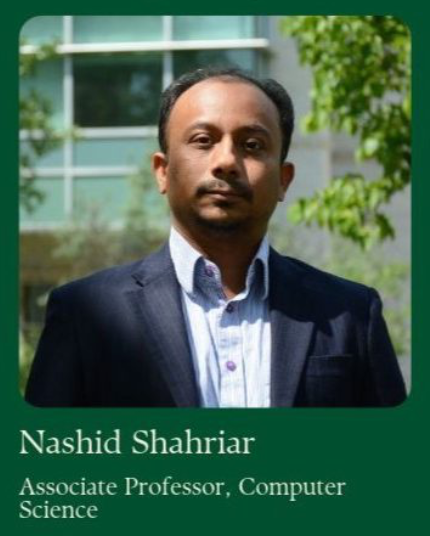 Dr. Nashid Shahriar is an Associate Professor in the Department of Computer Science at the University of Regina. He holds a PhD from the University of Waterloo and an MSc from Bangladesh University of Engineering and Technology. His research focuses on security, reliability, and performance management of computer and communication networks and critical infrastructure such as nuclear reactors and data centers. He received the University of Regina’s 2025 Faculty of Science Award for Research Excellence (Early Career Researcher category) and the IEEE Communications Society’s 2023 Young Professional Award (Network Operation and Management area). His research has earned multiple international honours, including Best Paper Awards at IEEE PST (2025, 2026) and IEEE/ACM/IFIP CNSM (2017, 2019), and the Best PhD Dissertation Award at IFIP/IEEE IM (2021).
Q&A
Q1: Much of your work looks at securing increasingly complex and connected technologies, including 5G, cloud infrastructure, and IoT. What cybersecurity challenges are emerging in these environments, and how is your research helping to address them?
My research studies how different types of cyberattacks affect communication networks and critical infrastructure, including 5G and 6G mobile networks, IoT, and nuclear reactors, and how we can mitigate these problems. These highly distributed and heterogeneous network environments introduce new attack surfaces and enable sophisticated cyberthreats, such as distributed denial-of-service attacks, compromised IoT devices and network functions, encrypted malicious traffic, supply-chain attacks, insider threats, and increasingly sophisticated AI-assisted attacks. To address them, my research develops tools, models, datasets, and techniques that can detect unusual network activity, mitigate intrusions, classify traffic, and identify threats like phishing or cyberbullying in online activities.
Q2: Cybersecurity research often needs to keep pace with technologies that are changing very quickly. How do you translate your research into approaches or solutions that can be applied to real-world cybersecurity challenges?
Cybersecurity research must continually evolve because each major technological transition (e.g., 4G to 5G and proliferation of IoT) changes both the attack surface and the nature of the threats that can emerge. More recently, generative AI tools are changing both sides of the security equation: they can improve threat detection and defense, but they can also enable more sophisticated phishing, malware, evasion, and automated attacks. I design my research to evolve as the technology changes, focusing on generalizable principles, adopting new techniques such as machine learning, AI, and large language models, and producing artifacts and solutions the broader cybersecurity community can adopt.
Q3: Looking ahead, where do you see the greatest potential for your research to make an impact, and are there opportunities for collaboration with researchers from other disciplines?
I see potential in bringing together AI, cybersecurity, and next-generation network technologies to create intelligent, secure, and resilient networks and critical infrastructures. My research has evolved from making virtual networks survivable to reliable 5G network slicing, to machine learning-based threat detection, and more recently to AI-driven network management and reasoning. The next step is to develop systems that can continuously observe a complex network or critical infrastructure, detect emerging threats, understand why they are occurring, and safely recommend or execute mitigation. Given my recent research endeavour for securing critical infrastructure, there are opportunities to collaborate with researchers working on smart grids, nuclear reactors, and data centers.
Q4: What University of Regina resources, supports, or partnerships have been particularly helpful in advancing your research?
The University of Regina helps advance my research by creating an inclusive, supportive research environment that nurtures intellectual curiosity and by providing scholarships and financial support to my students and postdoctoral fellows. The Graduate Advanced Training and Entrepreneurship Centre provides my students with professional development resources, industry networking opportunities, and initial support for research commercialization. One partnership worth mentioning is between our university and Purdue University, USA, which recently helped launch a new project to enhance the cybersecurity capabilities of nuclear and radiological sector personnel, creating a new avenue of research.