Does the flap of a butterfly's wings in Brazil set off a tornado in Texas?
That's the question mathematician and meteorologist Edward Norton Lorenz famously asked while describing what became known as the Butterfly Effect. The idea that something as small as the flutter of a butterfly's wing can set off a chain reaction, affecting something on the other side of the world.
Small actions can, in fact, make a big difference.
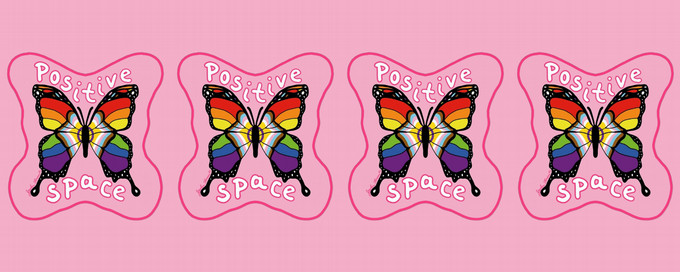
Very soon, a butterfly will take flight across the University of Regina campus, on office doors, classroom windows, and in university gathering spaces. The colourful design is the centrepiece of a new Positive Space sticker.
Even small pieces of public art can remind someone that they belong, that they are seen, and that they are not alone. — Jayden Thompson, Visual Arts, Faculty of Media, Art, and Performance.
Originally launched at the University of Toronto nearly three decades ago, the Positive Space initiative has since been adopted by post-secondary institutions across Canada.
"It's meant to make 2SLGBTQIA+ folks feel seen,” says Jayden Thompson, the artist behind the design and fourth-year visual arts student from the Faculty of Media, Art, and Performance (MAP). “It offers a reminder that someone here made space for us. For everyone else, it's a sign that we are queer and we are here.”
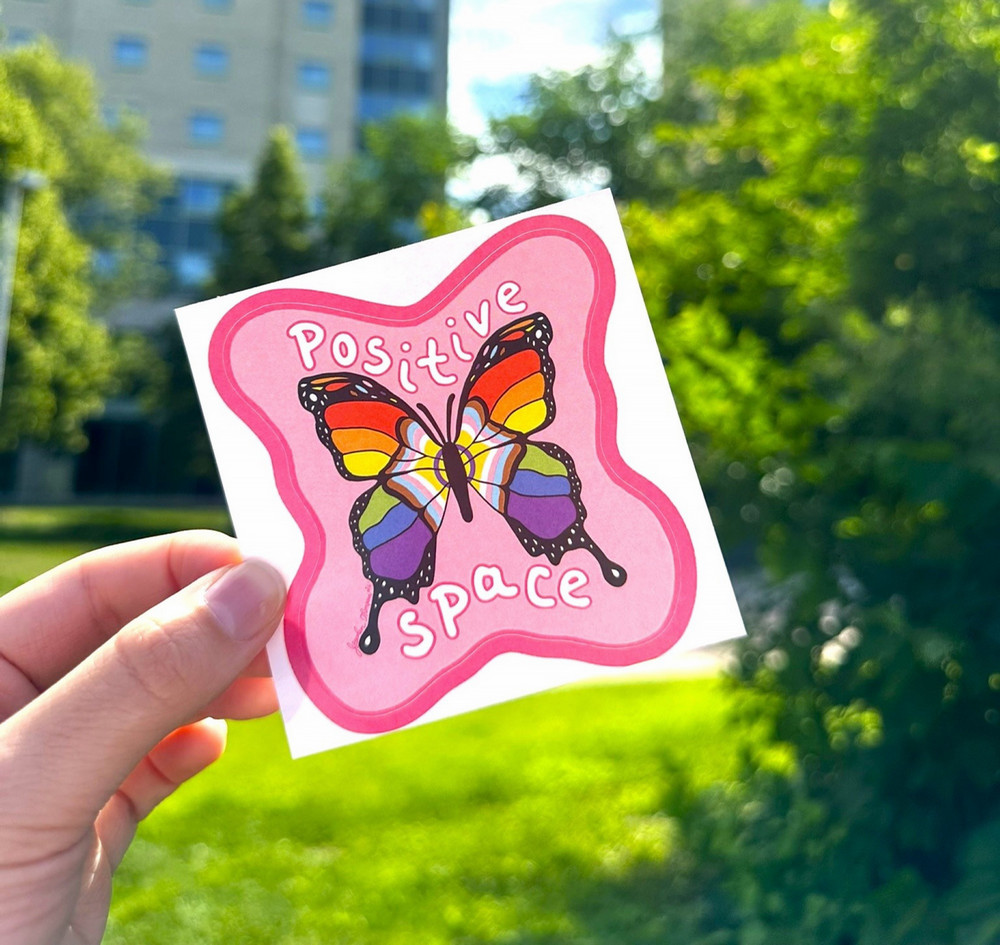
2026 Positive Space sticker by Jayden Thompson. Credit: University Communications and Marketing.
A positive space
Thompson imagines the ways the sticker can make a positive impact on people. They think of a student from a small town or an environment where being queer or trans can be dangerous. For that student, the sticker is a visible reminder that they are not alone, that there are people who see them for who they are and support them.
"I want the sticker to be a small but everyday reminder that queerness belongs here, that queer and trans lives are part of campus life, not just a marketing moment," says Thompson, referring to the way many brands and corporations limit their support to Pride Month.
For the design, Thompson drew inspiration from the UR Pride Centre for Sexuality & Gender Diversity’s butterfly logo. They experimented with several concepts and reworked the idea into something distinctly their own and something that would fit the U of R community.
"The University’s walls are for learning, teaching, archiving, and creating, so my work, even as a sticker, belongs on them,” says Thompson.
Whether displayed as artwork in a gallery or placed on a door as a butterfly sticker, Thompson believes art can create moments of comfort, solidarity, and reflection, helping people recognize themselves in a space.
“Even small pieces of public art can remind someone that they belong, that they are seen, and that they are not alone,” they say. “Knowing you aren’t alone, and that the space is there for you to take up, is so crucial to creating more inclusive and welcoming environments.”

Advocating for action
Thompson is careful not to overstate what a sticker can accomplish. "I think it's important to be honest about the limitations of symbolic gestures," they say.
While universities often express support for 2SLGBTQIA+ communities, Thompson points out that those commitments are not always reflected in meaningful action. They add that moments of silence, neutrality, or inaction when queer and trans community members face discrimination or exclusion are disheartening and can undermine messages of inclusion. Thompson advocates for sustained action to truly create the systemic change institutions need.
“But visible signs of inclusion still matter,” says Thompson. “They can push back against erasure and remind people that queer and trans communities exist here, have always existed here, and deserve to be seen."
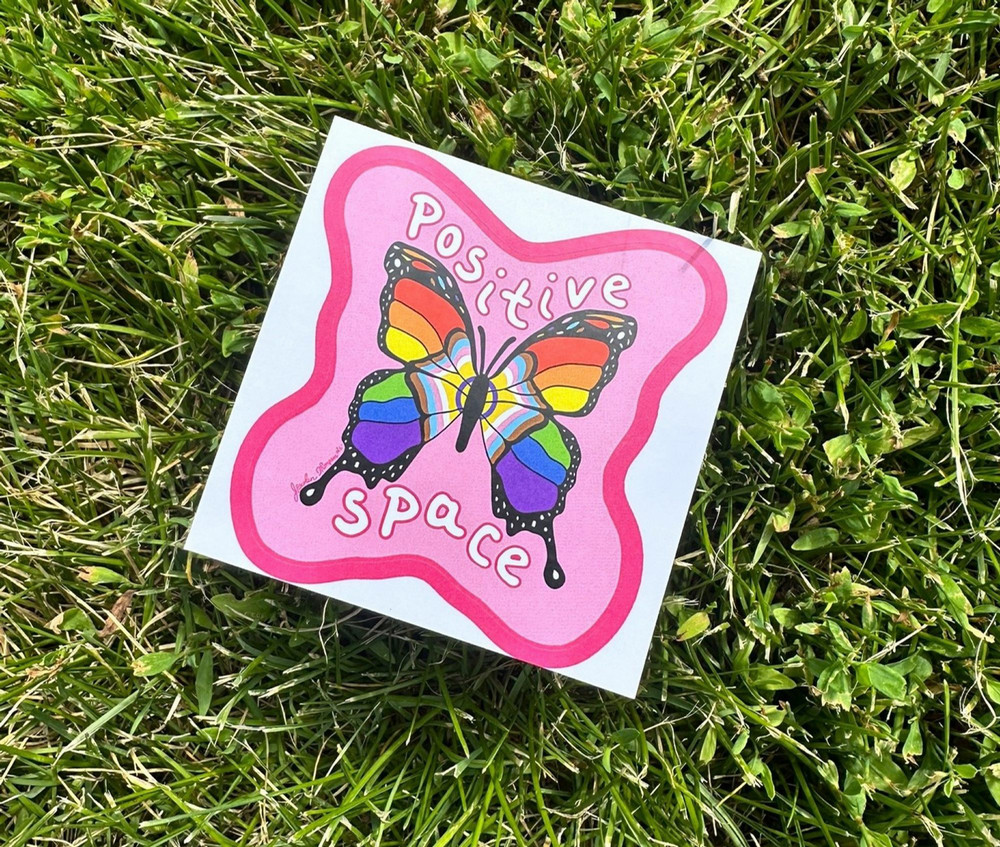
Positive Space Sticker on the Dr. Lloyd Barber Academic Green. Credit: University Communications and Marketing.
The artist
Thompson has always been creating art, though for much of their life they treated it as a hobby rather than a career. That changed during the COVID-19 pandemic, when they paused their biology studies and serendipitously enrolled in an art class that changed the course of their life.
“During that time, I fell in love with the artistic community, the instructors, the overall atmosphere, and even the unique smells of the visual arts wing where my art class was held,” says Thompson.
That experience led them to the U of R’s Visual Arts program, where they now concentrate in printmaking and photo-based arts. Thompson credits faculty members with shaping their artistic practice in concrete ways. Professor and department head Robert Truszkowski introduced Thompson to printmaking and his enthusiasm for the medium proved contagious, while Professor Risa Horowitz encouraged Thompson to move past the idea of working in a single medium, opening the door to experimentation.
Through art, Thompson explores identity, grief, memory, and queer and trans embodiment. Their practice spans intaglio, stone lithography, screen printing, photography, cyanotype, and other mixed-media processes.
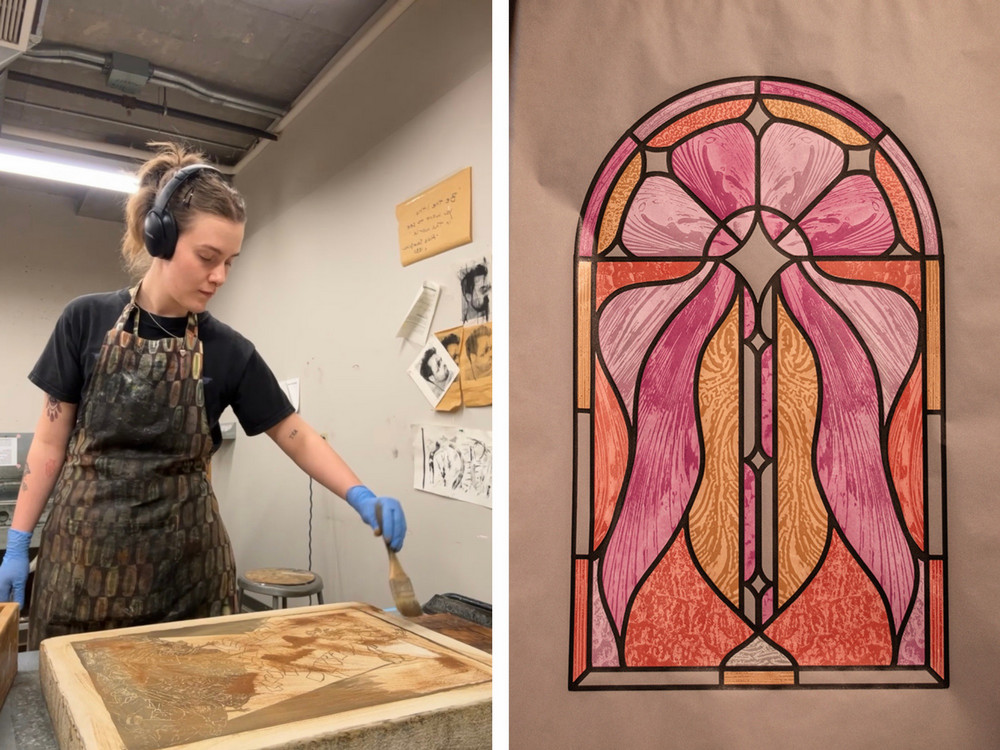
Jayden Thompson during the printmaking process (left) and Sappho Stain II, their 2026 screenprint on vellum (right). Credit: Jayden Thompson.
“I look for the material that can best hold my idea,” says Thompson. “Ambiguity and transformation are central to my artwork and to how I understand myself. Not everything needs to be fully explained. Some things are meant to be felt.”
That approach has been reflected in exhibitions in Regina and across Canada, including a nationally touring show. In 2025, Thompson curated their first solo exhibition, My Queer Art, in the University’s UR Pride space. This year, they are also collaborating with the Faculties of Science and MAP on an upcoming fundraiser.
Keep an eye out for Thompson's butterfly on campus. It may be a small addition to the University's walls, but for some, it could mean finding a place where they feel seen.
Interested in telling your story through art? Discover the programs available through the Visual Arts Department.
Stop by the UR Pride Lounge to pick up your own Positive Space sticker and help this butterfly spread its wings across campus.
About the University of Regina
At the University of Regina, we believe the best way to learn is through access to world-class professors, research, and experiential learning. We are committed to the health and well-being of our more than 16,600 students and support a dynamic research community focused on evidence-based solutions to today’s most pressing challenges. Located on Treaties 4 and 6—the territories of the nêhiyawak, Anihšināpēk, Dakota, Lakota, and Nakoda peoples, and the homeland of the Michif/Métis nation —we honour our ongoing relationships with Indigenous communities and remain committed to the path of reconciliation. Our vibrant alumni community is over 97,000 strong and enriching communities in Saskatchewan and around the globe.
Let’s go far, together.