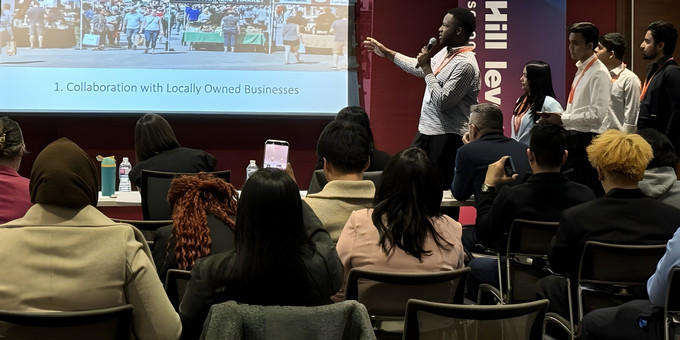
The clock was ticking. Inside Mosaic Tower at Hill Centre III, six teams of University of Regina students hunched over laptops and whiteboards, fine-tuning pitches they had been developing since the previous afternoon. Outside, downtown Regina stretched in every direction—the very streets they had been tasked with reimagining. In less than an hour, they would present their ideas before a panel of civic and business leaders.
What we have seen is the power of people. People coming together, making things happen, bringing education, bringing entrepreneurship, and bringing our community partners together. This is what innovation truly looks like. — Dr. Erin Oldford, Dean, Hill Levene School of Business, University of Regina
The Innovation Challenge 2026, organized by the Hill Levene School of Business in partnership with the Graduate Advanced Training and Entrepreneurship (GATE) Centre, brought together 30 participants from across six faculties for an intensive, nearly 24-hour sprint. The challenge: How can we revitalize Regina’s downtown through entrepreneurship, technology, and placemaking?
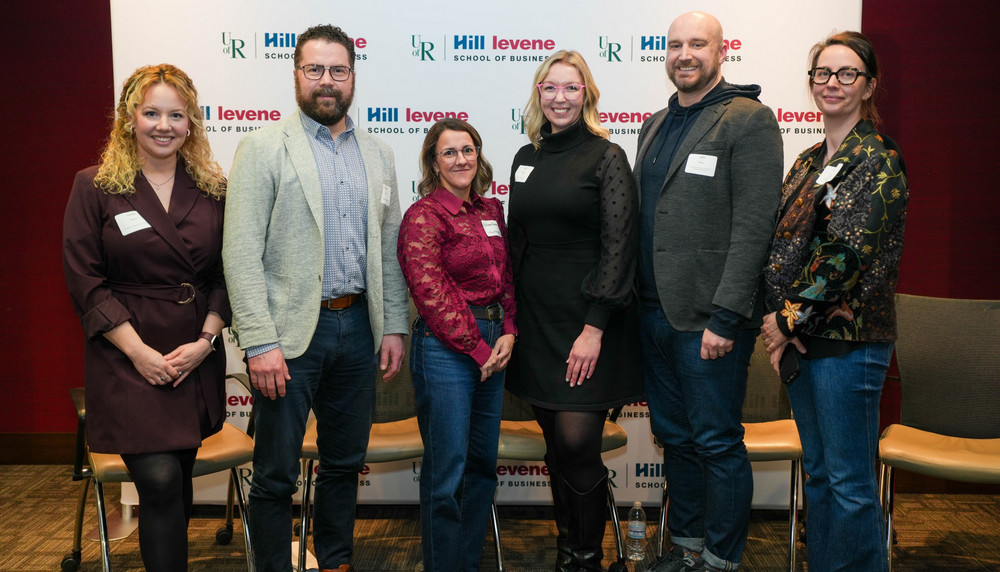
Students kicked things off by hearing from business and community leaders who unpacked the real issues at play, then worked alongside mentors who helped push their ideas further. With $5,000 in scholarships on the line and judges drawn from city council, corporate leadership, and the entrepreneurial community, the stakes felt anything but hypothetical.
Real problems, real judges, real pressure
The event took place in the very heart of downtown, intentionally shifting learning from the classroom to real-world experience. As Dean Erin Oldford explained, this exemplifies “Business Collision”: the moment when ideas, people, and sectors come together in meaningful ways.
“When you place emerging talent in the economic core of the city and ask them to wrestle with its future, you signal that the University is not adjacent to community transformation; it is embedded in it,” said Oldford.
Students formed interdisciplinary teams, meeting teammates from different faculties and majors. While the Hill Levene School of Business champions the power of “Business Collision” to spark new ideas, Colin Savage, Director of GATE, highlights the broader strategic value of interdisciplinary collaboration. Through diversity and inclusion, GATE supports distinct, multi-talented groups across faculties in unlocking unique solutions to specific, localized problems.
Savage noted, this collaboration—where an engineering student’s technical perspective meets asocial work student’s community insight—is where the real magic happens. “The resulting friction creates something neither could produce alone,” he said.
Six visions for a more vibrant downtown
By Saturday afternoon, teams pitched solutions ranging from a culturally inspired walking street to a centralized mobile app designed to address what one team called the “Visibility Gap” in downtown event marketing. The proposals were examined by an expert panel: Victoria Flores, a Regina city councillor and communications and marketing manager at the Regina Open Door Society; David Belof, vice chair of Deloitte Canada; and Laura Mock, director of Cultivator.

Belof set the tone before the first pitch, emphasizing the professional calibre he expected. “I am here to find the young stars that we’re going to hire,” the Deloitte exec told the room. “I believe there are a lot of great young stars here today.”
Flores, bringing a civic perspective to the panel, pushed teams to consider the inclusivity and long-term sustainability of their projects, while Mock challenged the students to ensure their pitches were scalable within the current local business ecosystem.
A fourth team introduced “The Urban Village,” an incubator model that temporarily houses businesses in vacant spaces, helping successful ventures transition to permanent tenancies. Harvard Developments, a Hill Company which hosted the challenge, noted that the students brought a “truly fresh and unbiased perspective” that challenged industry veterans to look at downtown through a fresh lens.
The winning idea: closing the visibility gap
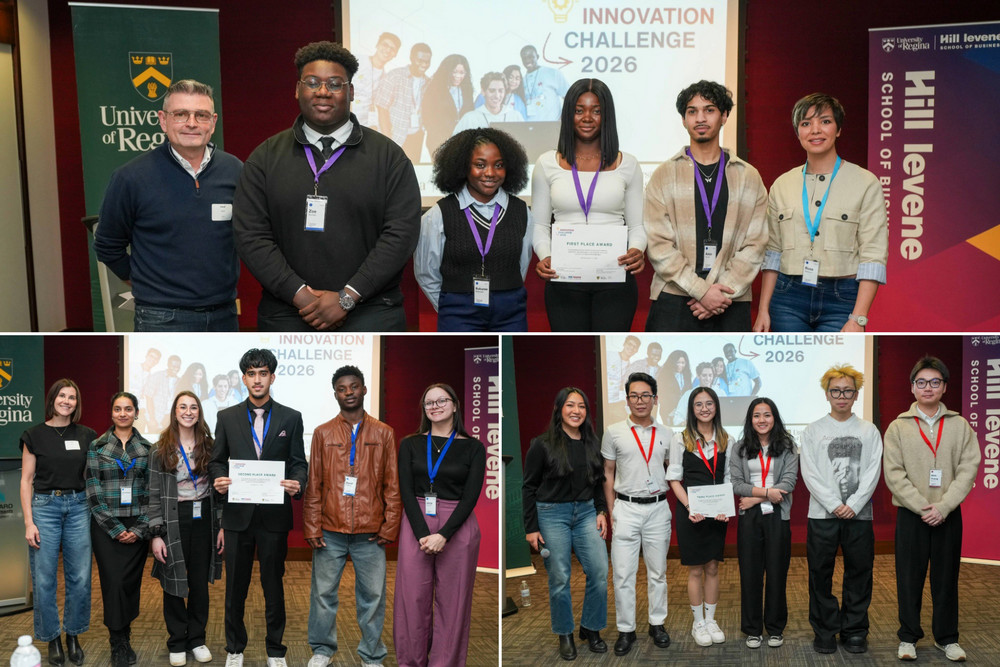
Top honours went to Team 6, whose members spanned business, computer science, and other disciplines, reflecting cross-faculty composition that defined the challenge. Their proposal addressed a personal concern: young people living in Regina simply do not know what is happening downtown. Their solution included modernizing physical marketing, launching a Youth Ambassador Program on social media, and building a centralized mobile application to unify transit, events, and community news.
Zoe Mishael, a Hill business student on the winning team, said the turning point occurred during a mentoring session. “Instead of questioning whether it would work, they immediately started building on it,” he recalled. “Seeing people with real experience genuinely believe in the idea gave us the confidence to fully commit to it.”
The advice was simple but transformative: step back from refining a single feature and focus on the root problem.
Mishael’s advice for students facing their next challenge is clear. “Take the leap. Step outside your comfort zone. You’ll gain far more than just a competition result; you’ll gain skills, confidence, and a new way of thinking about problems.”
Building networks that outlast the weekend
The event was supported by several community partners, including the Regina Public Interest Research Group (RPIRG), whose financial contribution helped bring the community together. For Hill Levene, the Innovation Challenge is about responsibly energizing progress.
Oldford emphasized, “We challenge students to think beyond ‘Can we?’ to ‘Should we?’ and ‘For whom?’ That combination with ambition rooted in responsibility, is what Saskatchewan needs in its next generation of leaders.”
For Hill Levene, the Innovation Challenge is part of a larger ecosystem of experiential learning programs that includes the Business Collision Space, the Fail Up entrepreneurship series, and the Voices of Impact webinar series. The second iteration of the Innovation Challenge attracted students from across faculties, addressed a locally focused issue, and was held off-campus and within the community for the first time. GATE’s flagship Startup 101 Bootcamp further extends this pipeline by helping students advance their ideas from concept to pitch.
Ready to turn your ideas into action? Explore the Hill Levene School of Business and discover how our innovative programs, like the Innovation Challenge and the Business Collision Space, connect students with real-world opportunities.
With the momentum of the Innovation Challenge, the next iteration is positioned to incorporate more voices, offer expanded opportunities to showcase and develop ideas, and amplify the impact of student-led solutions.
The ideas do not end here.
Banner photo: A U of R student participant presents his team’s “Local Business & Farmers’ Market Team-Up” proposal during the Innovation Challenge 2026. Credit: Hill Levene School of Business.
About the University of Regina
At the University of Regina, we believe the best way to learn is through access to world-class professors, research, and experiential learning. We are committed to the health and well-being of our more than 16,600 students and support a dynamic research community focused on evidence-based solutions to today’s most pressing challenges. Located on Treaties 4 and 6—the territories of the nêhiyawak, Anihšināpēk, Dakota, Lakota, and Nakoda peoples, and the homeland of the Michif/Métis nation —we honour our ongoing relationships with Indigenous communities and remain committed to the path of reconciliation. Our vibrant alumni community is more than 95,000 strong and enriching communities in Saskatchewan and around the globe.
Let’s go far, together.