Teaching & Learning,
Research,
Campus Life
For 27 years, Project Day has been the Faculty of Engineering and Applied Science’s signature capstone event — when students present months of real-world problem-solving to the industry professionals who may one day hire them. Fourth-year engineering students take questions as they stand beside their capstone projects, presenting eight months of work distilled into a single morning, while industry evaluators, faculty, and community members moved between the tables, asking the kinds of questions that shape careers.
A walk through the exhibition space revealed that the student body is actively engineering solutions for the economic and environmental hurdles facing the province today.
What’s also really inspiring is that many of these people who are coming to this event today, who are leaders in industry, are alumni of our university and alumni of our graduate program — Dr. Jeff Keshen, President and Vice-Chancellor, University of Regina
Dr. Jeff Keshen, President and Vice-Chancellor of the University of Regina, surveyed the crowded space, where major employers were engaging directly with students.
"As a university, we are very committed to connecting with the needs of our province, the aspirations of our government — particularly in its growth plan — and engineering students play an absolutely key role in that," Keshen said.
Securing national carbon capture infrastructure
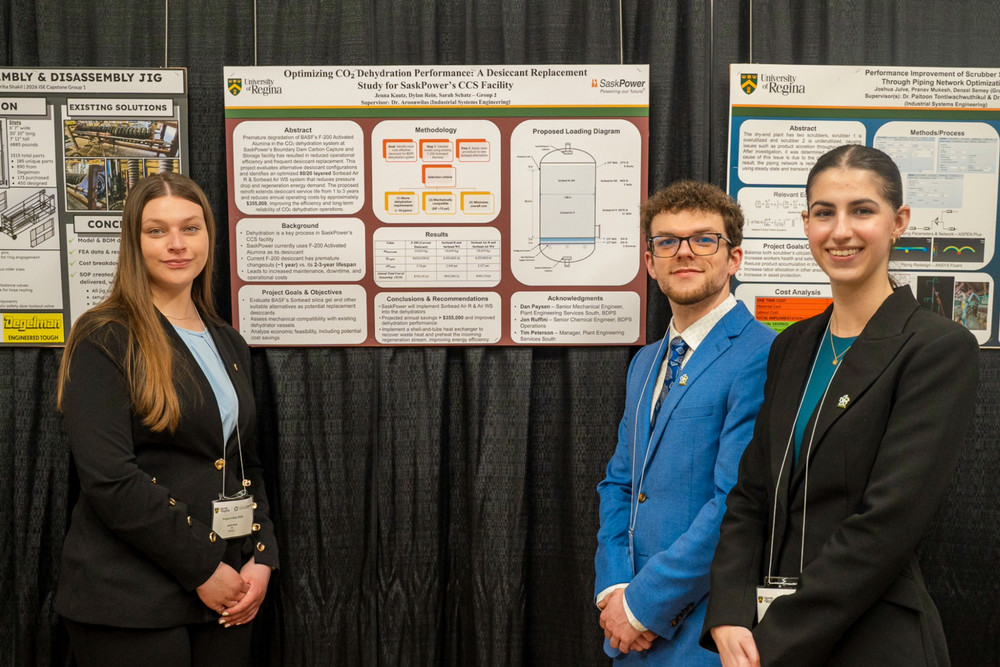
Securing Saskatchewan's energy future. Industrial Systems Engineering students (L–R) Jenna Kautz, Dylan Rein, and Sarah Schatz designed a turnkey optimization strategy for SaskPower’s Boundary Dam, protecting infrastructure that captures up to one million tonnes of CO₂ annually. Photo Credit: Faculty of Engineering and Applied Science
Saskatchewan’s carbon capture sector sits at the intersection of economic opportunity and environmental responsibility. For three industrial systems engineering students, Jenna Kautz, Dylan Rein, and Sarah Schatz, their capstone project gave them a hands-on look at how this works at one of the province’s most important sites: SaskPower’s Boundary Dam Carbon Capture and Storage (CCS) Facility.
Their challenge: figuring out how to stop desiccants — the materials that dry out captured carbon dioxide (CO₂) gas — from wearing out too quickly before the gas is compressed and stored, and finding a better replacement approach that could last longer, help the system run more efficiently, and reduce unnecessary maintenance.
This step is crucial. Every year, Boundary Dam traps between 800,000 and 1,000,000 tonnes of carbon dioxide, and the whole system depends on this dehydration process running smoothly.
“If the desiccants aren’t doing their job, nothing else works — there’s no way to dry the gas, and without that, there’s no carbon capture at all,” the team explained. “So it’s a small part, but it’s absolutely essential.”
Connecting Saskatchewan farmers with smarter data
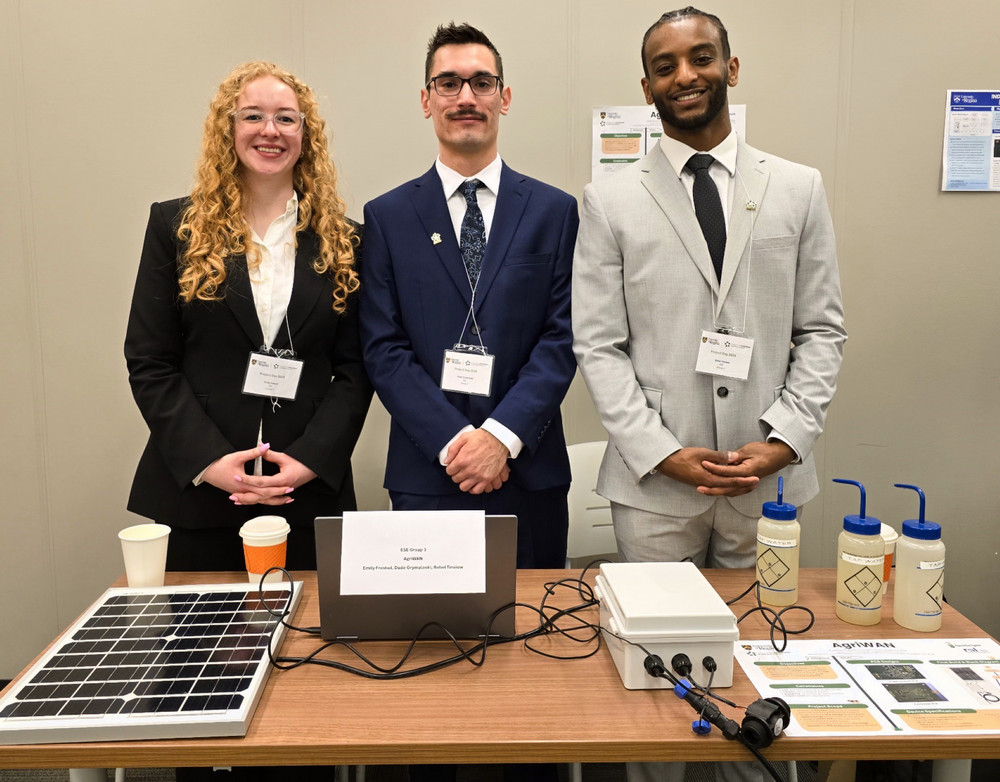
Engineering for the Prairies. Electronic Systems Engineering students (L–R) Emily Frostad, Dade Grymaloski, and Robel Tinsiew showcase their AgriWAN prototype. Partnering with local tech firm FarmSimple Solutions, the team designed a cost-effective, solar-powered monitoring device that eliminates the burden of high cellular data fees for Saskatchewan farmers. Photo Credit: Faculty of Engineering and Applied Science
In rural Saskatchewan, reliable data connectivity can be expensive and hard to come by. Electronic systems engineering students Emily Frostad, Robel Tinsiew, and Dade Grymaloski partnered with local farm-tech company FarmSimple Solutions to redesign an existing agricultural monitoring product.
The team's project, AgriWAN, replaces the device's expensive cellular connection with a Long-Range Wide Area Network (LoRaWAN) — a low-power private radio network — powered by a solar energy-harvesting system. The result? Farmers can transmit data from sensors monitoring water flow, pipe pressure, and livestock feeding troughs without paying cellular fees.
“With cellular, not only do you have to pay high monthly data rates, but you also have to buy additional modems,” explained Grymaloski.
“LoRaWAN has a longer range, and it’s also a lot more cost-effective because you don’t have that high monthly charge,” added Tinsiew.
The team successfully tested their prototype’s signal range across the U of R campus and in open fields before signing the intellectual property rights over to FarmSimple Solutions to take to market.
Gamifying the modern classroom
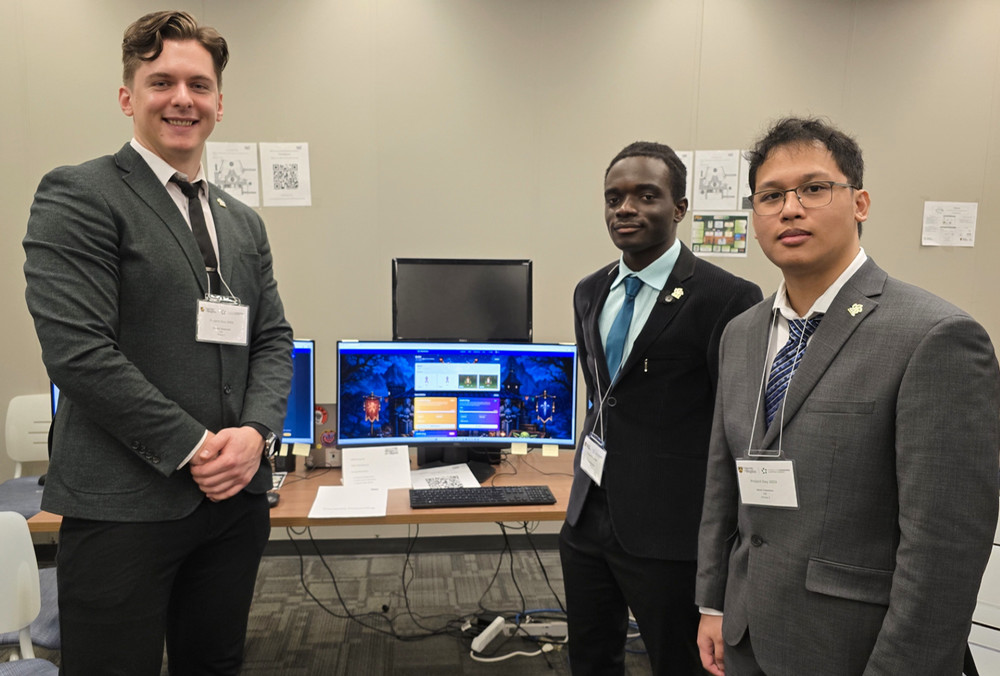
Levelling up learning. Software Systems Engineering students (L–R) Dmytro Stepaniuk, Tolani Oke-Steve, and Alvin John Tolentino showcase ClassQuest, an innovative ed-tech platform they designed to combat classroom disengagement by turning routine school assignments into interactive role-playing quests. Photo Credit: University Communications and Marketing
Anyone who’s sat through a flat slide-deck lecture knows the struggle to stay focused. Software systems engineering students Dmytro Stepaniuk, Alvin John Tolentino, and Tolani Oke-Steve built a browser-based gamification platform called ClassQuest to tackle student disengagement head-on.
Designed for upper elementary and middle school classrooms, ClassQuest turns routine assignments into interactive role-playing quests. Students earn experience points and gold for completing work, while teachers use the platform as a real-time analytics dashboard to identify who needs extra support.
“It’s an educational project that turns boring assignments into fun, adventure-style games," explained Stepaniuk.
Students complete quizzes and assignments inside collaborative teams, which the platform calls “guilds,” where classmates who have already grasped the material help bring others up to speed before a test.
Healing industrial landscapes
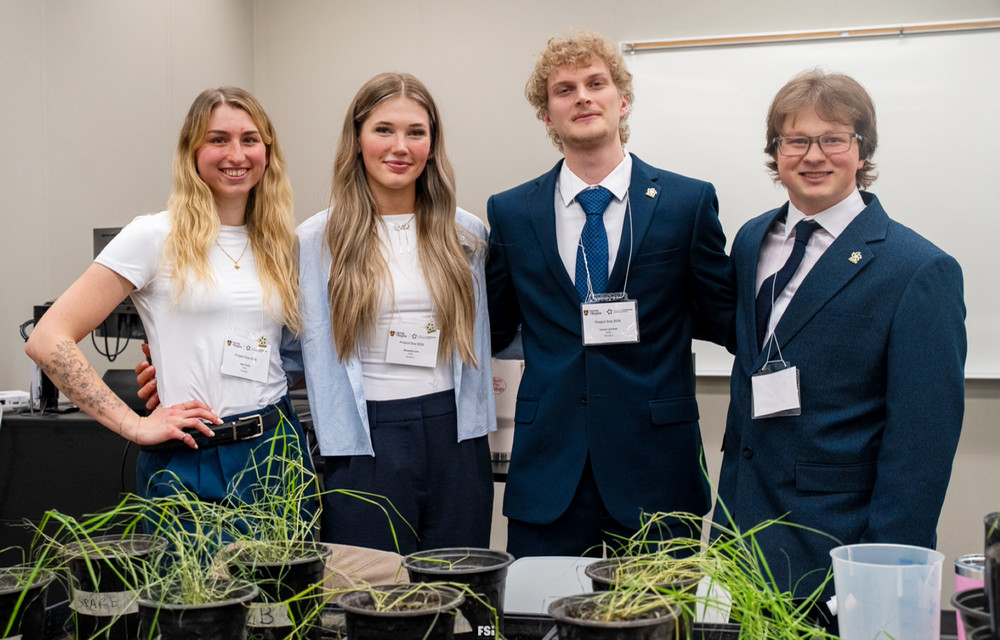
Healing Saskatchewan's landscapes. Environmental systems engineering students (L–R) April Gette, Alexandra Lenz, Carson Leischner, and Mason Lakustiak display the salt-tolerant plants central to their phytoremediation capstone project. Designed for the province's oil, gas, and potash sectors, their sustainable framework restores brine-contaminated soil without the carbon-heavy footprint of traditional excavation. Photo Credit: Faculty of Engineering and Applied Science
For environmental systems engineering students April Gette, Carson Leischner, Mason Lakustiak, and Alexandra Lenz, the project came to the university through a connection one team member made during a prior U of R co-op placement — a textbook case of the faculty's experiential learning model working exactly as designed.
The challenge: soil contaminated by industrial brine — the salty, mineral-heavy wastewater produced by the oil, gas, and potash sectors. The team's multi-phase remediation design uses gypsum and water to flush salt out of the soil, followed by salt-tolerant plants that pull what's left through their roots, restoring the land so ordinary crops can grow again.
"Our design kept land disturbance and carbon footprint in mind," the team explained. "The whole design was to ensure that what we're doing to restore the soil doesn't negatively impact the surrounding environment or the surrounding air with additional emissions.”
Making campus equipment easier to share
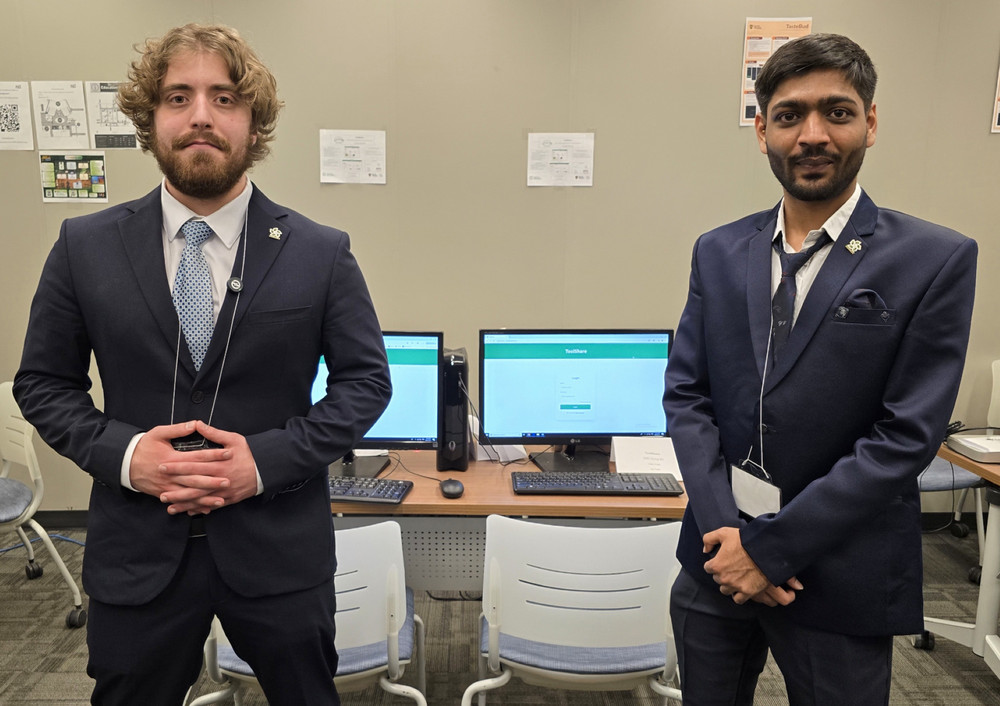
Streamlining the campus experience. Software Systems Engineering students (L–R) Isaac Kydd and Jay Patel showcase ToolShare, a centralized, Amazon-style equipment-booking platform designed to modernize and unify the way U of R faculty manage their lab resources. Photo Credit: University Communications and Marketing
Software systems engineering students Jay Patel and Isaac Kydd developed ToolShare, a single platform to streamline borrowing systems scattered across the university campus. Cameras, microphones, lab tools, and other gear are typically tracked differently by each faculty, some by third-party software, some on spreadsheets, and some by pen and paper.
ToolShare lets students and staff check availability, book what they need, and track their reservations in one place; faculty and lab instructors manage inventory and approve requests from the same dashboard.
"We built ToolShare because, right now, every faculty at the U of R has its own system for borrowing items," said Kydd. "Our goal was to make it simple and unified so everything can be managed in one place."
Dr. Phillip Choi, Dean of the Faculty of Engineering and Applied Science, said the faculty’s strong industry partnerships keep Project Day relevant year after year — and keep student work grounded in real problems.
Watch the highlights from Project Day 2026 to experience the energy on the floor and see how our students are actively building Saskatchewan’s future.
“I can see a bright future for the province,” Choi explained. “In fact, when we talk about developing the economy in the province, you need more and more engineers to build things so that our economy can prosper.”
Project Day 2026 offered a preview of the engineers, innovators, and problem-solvers who will shape the province for decades to come.
From safeguarding energy infrastructure to advancing agriculture, Project Day 2026 proves U of R engineering students are already building the future.
“What’s also really inspiring is that many of these people who are coming to this event today, who are leaders in industry, are alumni of our university and alumni of our graduate program,” Keshen said. “They recognize the talent; they recognize the contributions. I’m just blown away with the future that they indicate that they’re going to be having.”
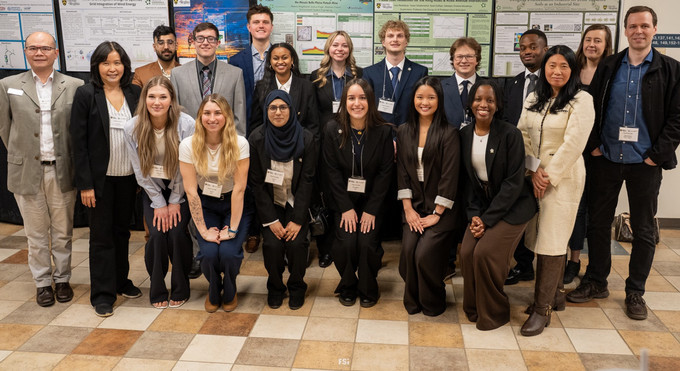
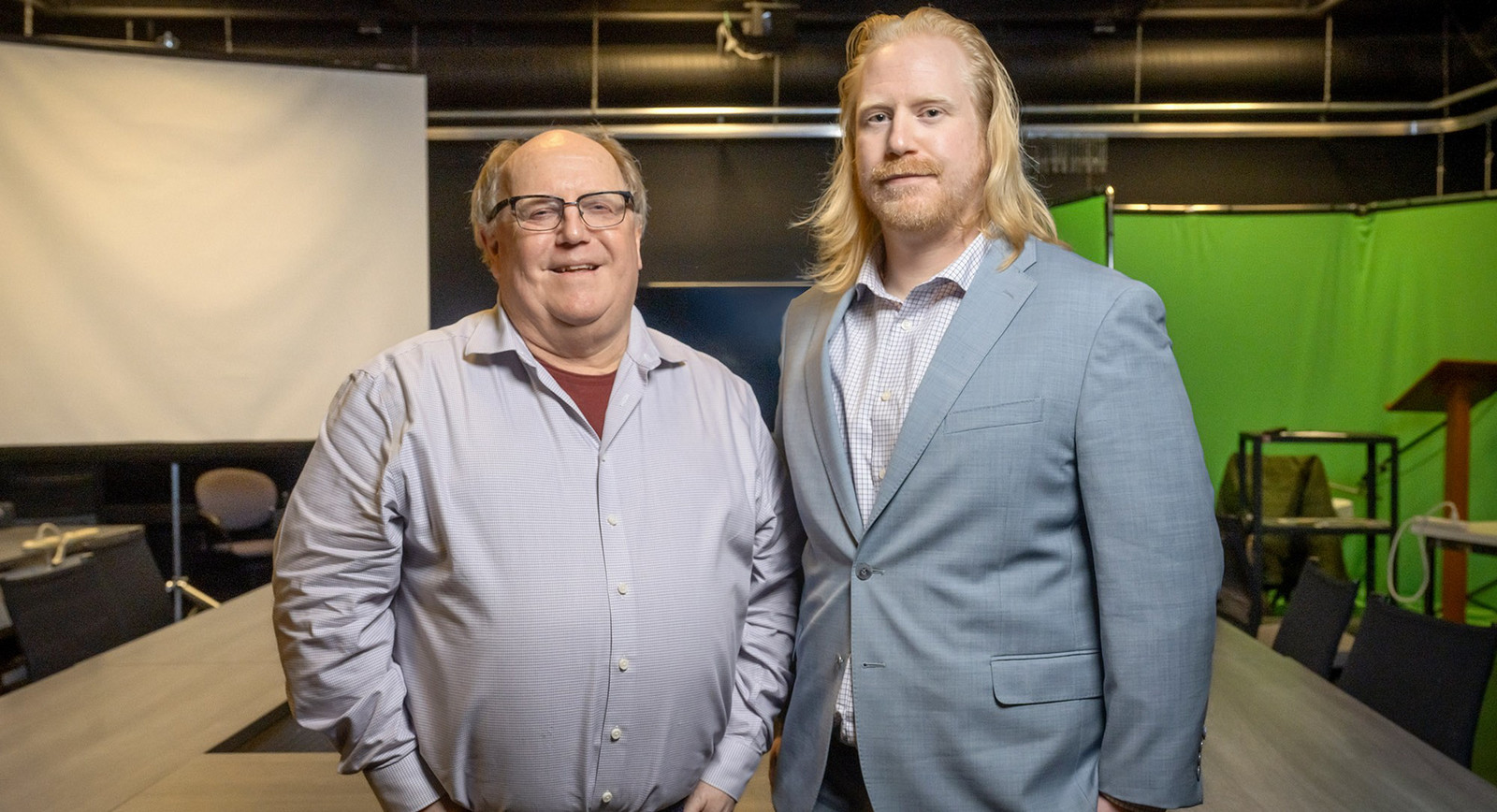
Banner image: The faces of Saskatchewan's economic future. Graduating U of R engineering students stand alongside faculty members at Project Day 2026, where they pitched innovative, industry-ready solutions to major employers and community leaders. Photo Credit: Faculty of Engineering and Applied Science
About the University of Regina
At the University of Regina, we believe the best way to learn is through access to world-class professors, research, and experiential learning. We are committed to the health and well-being of our more than 16,600 students and support a dynamic research community focused on evidence-based solutions to today’s most pressing challenges. Located on Treaties 4 and 6—the territories of the nêhiyawak, Anihšināpēk, Dakota, Lakota, and Nakoda peoples, and the homeland of the Michif/Métis nation —we honour our ongoing relationships with Indigenous communities and remain committed to the path of reconciliation. Our vibrant alumni community is more than 95,000 strong and enriching communities in Saskatchewan and around the globe.
Let’s go far, together.
Related Posts
Community,
Teaching & Learning
Best and brightest: U of R welcomes 14 future leaders on full Chancellor’s Scholarships
Teaching & Learning,
Community,
Truth & Reconciliation,
Research,
Campus Life
New Video Celebrates Vision of University of Regina’s New Strategic Plan
Campus Life,
Teaching & Learning,
Alumni