Campus Life,
Truth & Reconciliation,
Community
A new exhibit at the Dr. John Archer Library and Archives is giving visitors a firsthand perspective at a previously unseen part of Saskatchewan’s history.
The Native Brotherhood at Saskatchewan Penitentiary Exhibit is filled with displays made up of articles and photos that each represent a different part of the Native Brotherhood’s story.
Born out of a five-year long research project, associate professor of English, Dr. Jason Demers helped collect material across Canada and collaborated with Elders involved in the brotherhood.
I think the biggest thing is trying to unbox the boxing-in of the human beings who end up behind bars. We tend to understand incarcerated people through stereotypes and this project hopefully breaks down those stereotypes so we can see the complex human beings residing in every cell. — Jason Demers, Associate Professor of English, University of Regina
The exhibit tells a story of resilience through news articles, letters, and poetry that date back to the 1960s and 1970s.
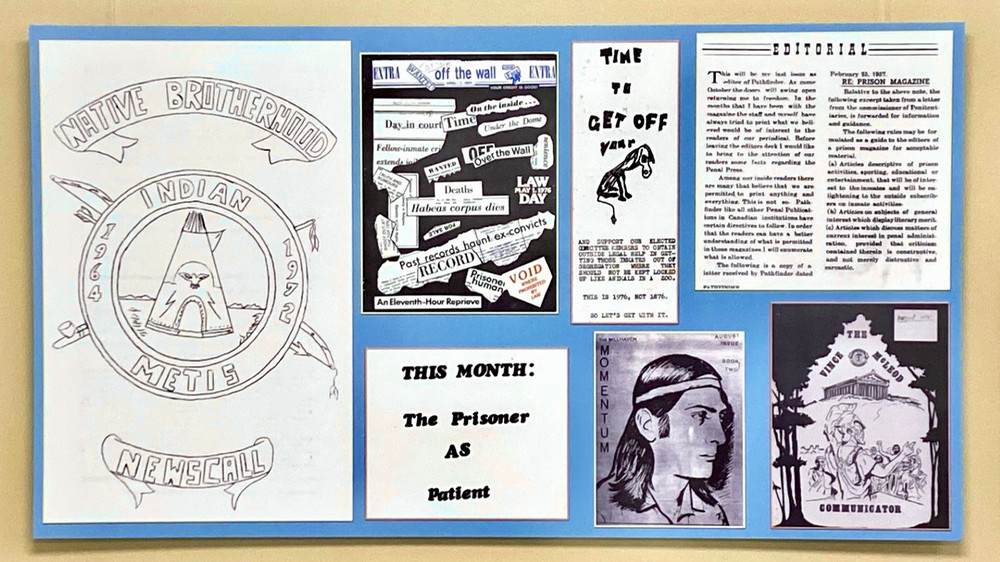
A display featuring some of the articles and artwork from the Native Brotherhood. Credit: Photo by University Communications and Marketing
Connecting the past and the present
Also on display is artwork created by Indigenous men who are currently incarcerated at the Saskatchewan Federal Penitentiary. These pieces help tie the past to the present, showcasing a culture that’s still alive.
“It would be kind of a perpetuation of the speaking over Indigenous voices if we didn't allow them to contribute,” says Emily Reid, a student research assistant at the U of R. “But also the fact that artwork was purchased from them just kind of shows that this flourishing culture is still existing in prison, and it's kind of a celebration of that.”
Reid had the opportunity to scan the decades-old material and make these writings available digitally for the first time, making it possible to have them on display.
Curated by Demers, Elder Erroll Kinistino, Elder Harvey Knight, Kihêw Flamont, Josie Linka, and Emily Reid, the exhibit showcases some of the work that went into establishing an Indigenous identity in a prison environment and how it’s only continued to grow.
“A whole infrastructure has now developed to allow Elders, pipe ceremonies, and sweats inside, all as a result of the hard work that people did back in the 60s and 70s—even facing punishment like being sent to ‘the hole’,” says Demers
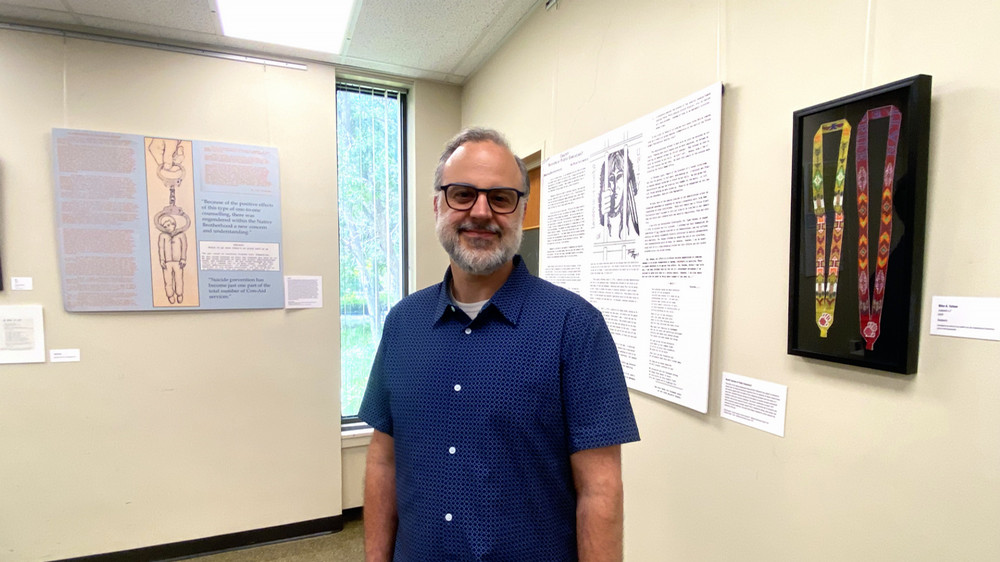
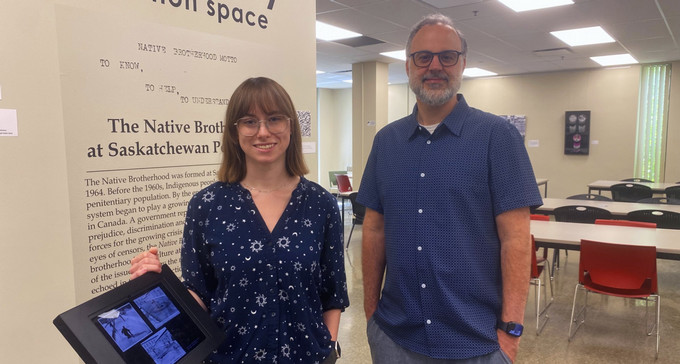
Jason Demers stands in front of one of the displays in the exhibit. Credit: Photo by University Communications and Marketing
The exhibit offers visitors an opportunity to hear directly from the individuals involved about an issue that’s still relevant 50 years later.
“With an exhibit like this it would be easy to fall under more of a scholarly perspective and rely on a lot of the material written about the Sask Pen and written about the movement from outside scholars,” says Reid. “But we really wanted to take such an amazing primary source and have that speak for itself and speak on behalf of the inmates who wrote it.”
The exhibit also reflects a broader commitment taking shape across the University of Regina. One of the five priorities in the University's new strategic plan, Together, We Put Things Right, acknowledges the importance of confronting difficult histories and creating space for Indigenous voices, perspectives and experiences.
Want to learn more about the Archway Exhibition Space? Visit the Dr. John Archer Library and Archives
“I think the biggest thing is trying to unbox the boxing-in of the human beings who end up behind bars” says Demers. “We tend to understand incarcerated people through stereotypes, and this project hopefully breaks down those stereotypes so we can see the complex human beings residing in every cell.”
On top of the visual aspects, all material is available in an audio format read by Indigenous voice actors.
Ultimately, the exhibit highlights Indigenous voices that have gone unheard and showcases the continued relevance of issues like Indigenous overrepresentation in prison.
Banner photo: Jason Demers speaks at the Native Brotherhood at Saskatchewan Penitentiary opening celebration. Credit: Photo by University Communications and Marketing
About the University of Regina
At the University of Regina, we believe the best way to learn is through access to world-class professors, research, and experiential learning. We are committed to the health and well-being of our more than 16,600 students and support a dynamic research community focused on evidence-based solutions to today’s most pressing challenges. Located on Treaties 4 and 6—the territories of the nêhiyawak, Anihšināpēk, Dakota, Lakota, and Nakoda peoples, and the homeland of the Michif/Métis nation —we honour our ongoing relationships with Indigenous communities and remain committed to the path of reconciliation. Our vibrant alumni community is over 97,000 strong and enriching communities in Saskatchewan and around the globe.
Let’s go far, together.
Related Posts
Teaching & Learning,
Campus Life,
Community
2026 Spring Convocation - Celebration of Achievement, Community, and Lifelong Connections
Teaching & Learning,
Community,
Campus Life