
Campus Life,
Teaching & Learning,
Community
There’s an exciting year ahead for musicians at the University of Regina, and it’s already sounding oh-so-good.
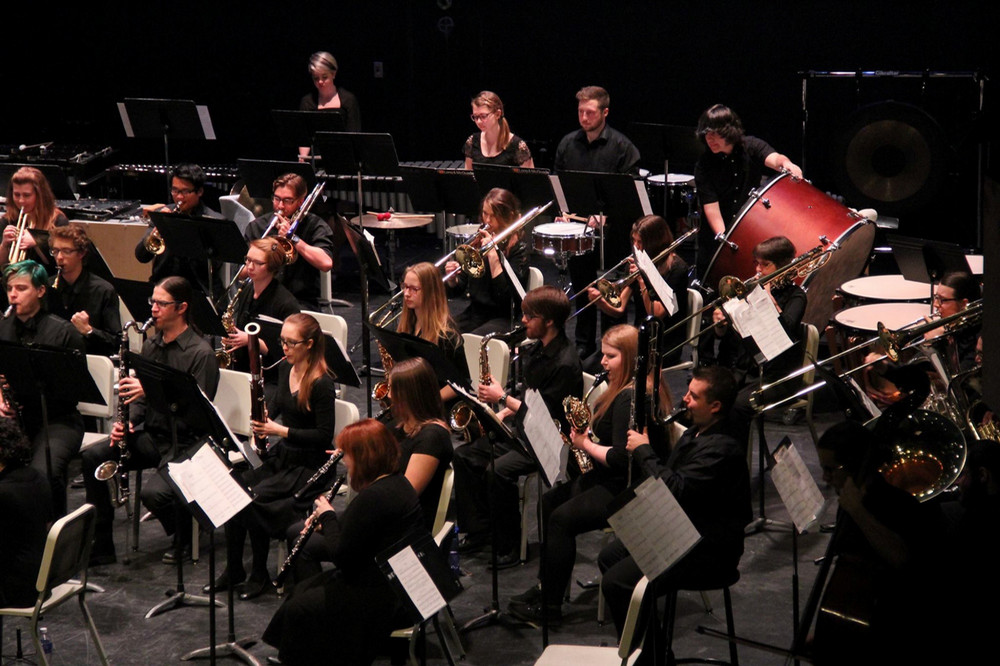
From wind ensemble and chamber singers to jazz band and concert choir, the U of R offers a symphony of opportunities for musicians to keep playing and keep learning on campus. The best part is you don’t have to be a music major to join in.
It is critically important that students have access to music education and opportunities to make music. The benefits are undeniable, and a student who has such opportunities is much more well-prepared for the world in so many ways. — Cheryl Ferguson, Assistant Professor and Director of Bands and Instrumental Conducting, Faculty of Media, Art, and Performance
Why keep playing?
University life gets busy, between classes, assignments, exams, work, and everything else constantly competing for your attention, it can be easy to set aside the things you enjoy most. Don’t let music be one of them.
“Being an active part of music making is so important, regardless of a student’s degree program,” says Cheryl Ferguson, the U of R’s new director of bands and instrumental conducting in the Faculty of Media, Art, and Performance (MAP). “Playing an instrument has been shown to have an impact on improved memory and cognitive function, it can boost mood, provide emotional regulation, offer stress relief, improve fine motor skills, and enhance hand-eye coordination.”
According to Ferguson, an award-winning director and educator, participating in an ensemble can also help develop skills that students can carry into virtually any career, including problem-solving, attention to detail, communication, and collaboration.
“There have even been numerous studies that link involvement in instrumental music to enhanced academic performance,” she adds.
Making music also has many social benefits. It's a chance to step away from the demands of school and meet people outside your program. Ferguson says the regularly scheduled rehearsals give students time to connect with other members of the university community and learn about the world and one another through music.
Why music education matters
“It is critically important that students have access to music education and opportunities to make music. The benefits are undeniable, and a student who has such opportunities is much more well-prepared for the world in so many ways,” says Ferguson.
This, she argues, is more important than ever in today’s world.
She points out that students today are faced with a technology-driven world where devices are robbing them of opportunities to optimally develop cognitively and socially. In a way, music education is an essential counterbalance to modern digital life.
“Being a part of an instrumental ensemble allows for the brain-enhancing use of instruments over devices and gives students a collaborative experience that can lead to an unmatched experience of connecting the mind, the body and the spirit,” she says.
While many digital activities position young people as consumers of content, instrumental music challenges them to be creators. Music offers opportunities for deep concentration, face-to-face collaboration, and creative expression that technology alone cannot provide.
Ferguson is looking forward to providing students with these opportunities through U of R ensembles and collaborations with MAP.
A new chapter for U of R music
At the end of 2025, the U of R said a heartfelt goodbye to Brent Ghiglione, a cherished member of the university community who retired from his role as director of bands after more than 20 years. Now, Ferguson is taking up the baton and bringing with her a deep passion for helping musicians discover where music can take them.
“It is invigorating to think about the possibilities in this new role, and I can’t wait to dive into more experiences connecting human beings through music,” she says.

Ferguson has decades of experience working with Canadian musicians of all ages. Before joining the U of R, she served as director of bands at Canadian Mennonite University and spent 20 years leading the band program at Winnipeg's Fort Richmond Collegiate, where her ensembles earned more than 50 gold-medal performances at the national finals of MusicFest Canada.
She has also presented on a variety of topics in music education, with a particular focus on student motivation, including a widely viewed TED Talk, Motivating People to Excellence. Now calling U of R home, she will conduct the Wind Ensemble and Concert Band while teaching instrumental conducting and brass techniques.
“One of the unique aspects of working with university students in music is helping them to discover what direction their path may take. There are so many ways that music can be a part of a career journey, and it is very rewarding to help students find a path that fits well with their strengths and goals,” says Ferguson.
In her experience, the connections made through music are long-lasting. Even years after graduating, former students continue to reach out to her to share where life has taken them and how music remains a part of their journey.
“We have all experienced the transformative power of music. I am so fortunate to be able to fill my entire life with music and witness that transformation in myself and others on a daily basis,” she says. “It is thrilling to be a part of such a dynamic and impactful subject matter as my life’s work.”
With Ferguson at the helm, music at the U of R is in great hands.
So, what are you waiting for?
If the idea of an audition feels intimidating, don’t let it keep you from exploring the U of R’s music ensembles.
Some ensembles require an audition, but many are open to everyone. If you’re interested in an auditioned ensemble, think of auditions as a placement. It’s a chance to share your musical experience, discover which ensemble is the best fit, and meet the people you’ll be making music with. After all, the idea isn’t to keep musicians out, but to get more musicians playing.
So, if there’s an instrument you’ve been meaning to pick up again or you’ve always wanted to learn, maybe this is the year to make some music.
Find your rhythm. Explore the U of R ensembles today.
Banner Image: This grand piano awaits its next moment in the spotlight at the Riddell Theatre. Credit: University Communications and Marketing
About the University of Regina
At the University of Regina, we believe the best way to learn is through access to world-class professors, research, and experiential learning. We are committed to the health and well-being of our more than 16,600 students and support a dynamic research community focused on evidence-based solutions to today’s most pressing challenges. Located on Treaties 4 and 6—the territories of the nêhiyawak, Anihšināpēk, Dakota, Lakota, and Nakoda peoples, and the homeland of the Michif/Métis nation —we honour our ongoing relationships with Indigenous communities and remain committed to the path of reconciliation. Our vibrant alumni community is over 97,000 strong and enriching communities in Saskatchewan and around the globe.
Let’s go far, together.
Related Posts

Community,
Research,
Campus Life,
Teaching & Learning
Global spotlight helps advance U of R’s strategic research enterprise
Teaching & Learning,
Research,
Community
From Boots on the Ground to Eyes in the Sky: AI Advances Saskatchewan Agriculture
Campus Life,
Community,
Teaching & Learning