Campus Life,
Community
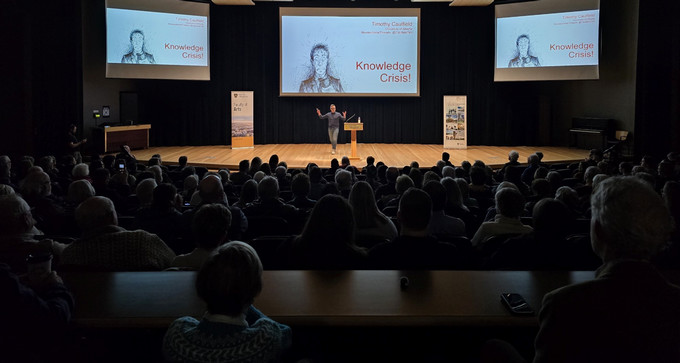
The seats filled fast. By the time Timothy Caulfield took to the podium for the 2026 Woodrow Lloyd Lecture, every chair in the Education Auditorium was taken. The audience, faculty, students, healthcare professionals, and community members alike, had come because the subject demanded it. It was the largest crowd the lecture series had drawn since before COVID, a sign of just how ready the community is to confront one of the most pressing challenges of our time.
Caulfield, a professor in the Faculty of Law and the School of Public Health at the University of Alberta, and a member of the Order of Canada, delivered a blunt message: we are living in the middle of a knowledge crisis, and it is threatening our democracy.
The first thing we need to do… is teach critical thinking skills. We should start teaching critical thinking skills in kindergarten and continue teaching them throughout grade school, high school, and university. It should be fundamental. This is a generational problem. — Timothy Caulfield, Professor, Faculty of Law and School of Public Health, University of Alberta
A lecture rooted in the history of Saskatchewan
The evening was a reminder of what the University of Regina was built to do: create knowledge and seek truth. It also honoured the institutional legacy that makes such public discourse possible.
The Woodrow Lloyd Lecture, funded by the Woodrow Lloyd Trust and presented each winter by the Faculty of Arts, honours Saskatchewan’s eighth premier. Lloyd is best remembered for implementing Medicare following the divisive doctors’ strike of 1962, but his impact on education was equally profound.
“He was a strong and vocal advocate for the expansion of post-secondary education in the province and laid the cornerstone of the first building of the Regina campus… that campus, of course, became the University of Regina,” Associate Dean of Arts for Research and Graduate Studies Tom McIntosh told the audience.
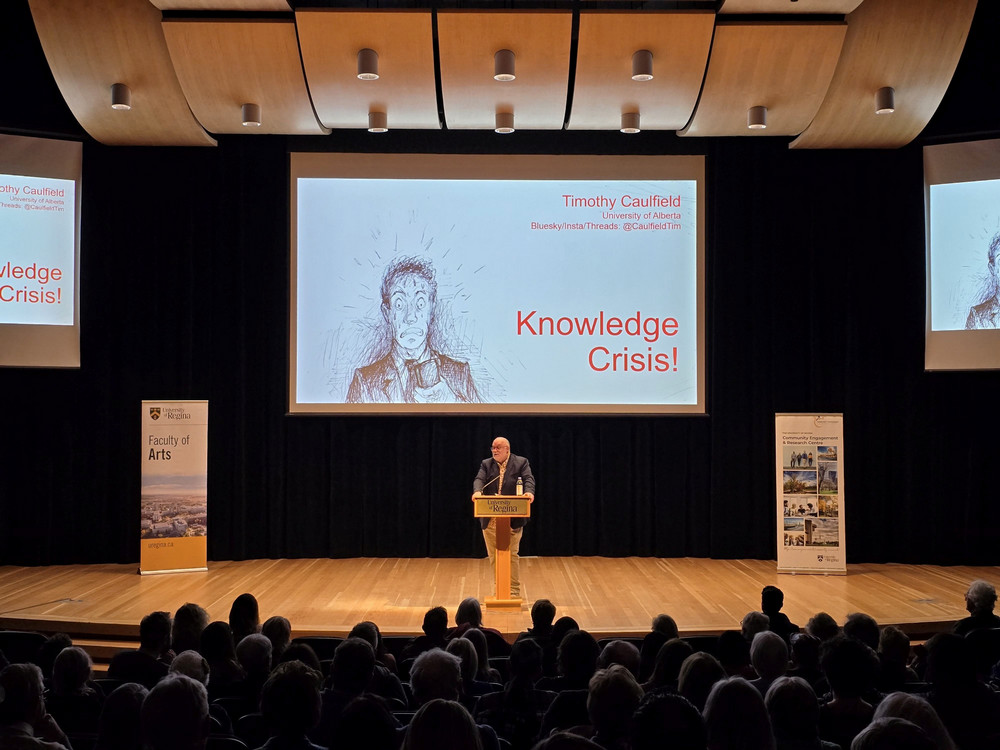
McIntosh introduced Caulfield as a scholar who is “tireless in his mission to combat public health illiteracy and to expose the hucksters, fraudsters, and conspiracy theorists that have wreaked havoc on public health systems across the globe.”
How celebrity culture and algorithms fuelled a crisis
Caulfield meticulously traced the arc of health misinformation. What began as alternative wellness in the 1960s counterculture evolved through the commercialization of fitness and into the rise of celebrity influencers like Dr. Oz and Gwyneth Paltrow. Today, he noted, misinformation has become deeply tethered to political identity.
While examples of pseudoscientific wellness products and improbable, celebrity-endorsed treatments drew laughter from the crowd, Caulfield was careful to show where the absurdity leads. “Misinformation is killing people,” he stated plainly, noting that the spread of falsehoods is a leading reason vaccination uptake is dropping in developed nations.
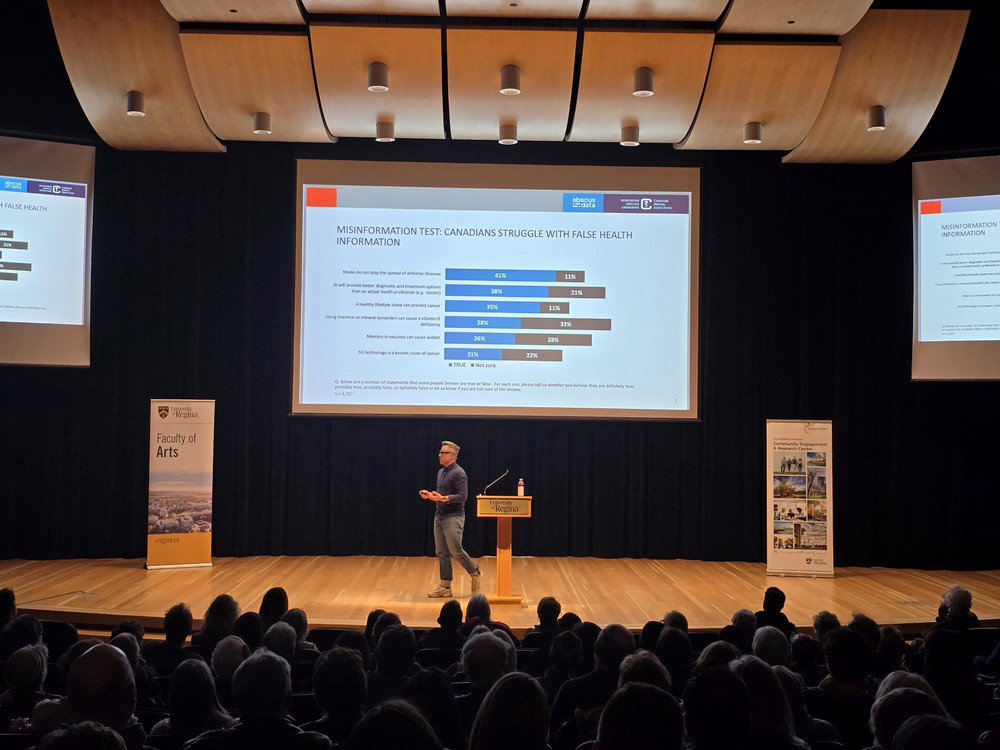
Social media has only compounded the emergency. Caulfield noted that a recent analysis of Meta platforms found 75 per cent of content is shared without the user ever clicking through. The result: an information environment shaped by algorithms engineered to reward extreme, outrage-driven content rather than critical thinking.
With the rapid integration of artificial intelligence, he warned, the landscape is becoming even more treacherous. “AI is the next battleground,” Caulfield said, noting that algorithms are evolving so quickly that research is nearly out of date by the time it is published.
Compassion over blame: A multi-pronged response
Despite the gravity of his assessment, Caulfield offered a hopeful, actionable framework for fighting back. His prescription: a multi-pronged strategy of prebunking, debunking, nudging, and regulating. He advocates for simple daily nudges, such as pausing to verify the scientific consensus before sharing an emotional post, alongside systemic changes such as enforcing truth-in-advertising laws.
But the starting point, he argued, is education. “The first thing we need to do is teach critical thinking skills,” Caulfield told the crowd. “We should start teaching critical thinking skills in kindergarten and continue teaching them throughout grade school, high school, and university. It should be fundamental. This is a generational problem."
Perhaps Caulfield’s most resonant message was his call for empathy. “We should never blame the individuals who are looking for answers,” he said. “We have an information environment largely shaped by emotional responses, not by critical thinking. We need to be compassionate.”
The U of R advantage in action
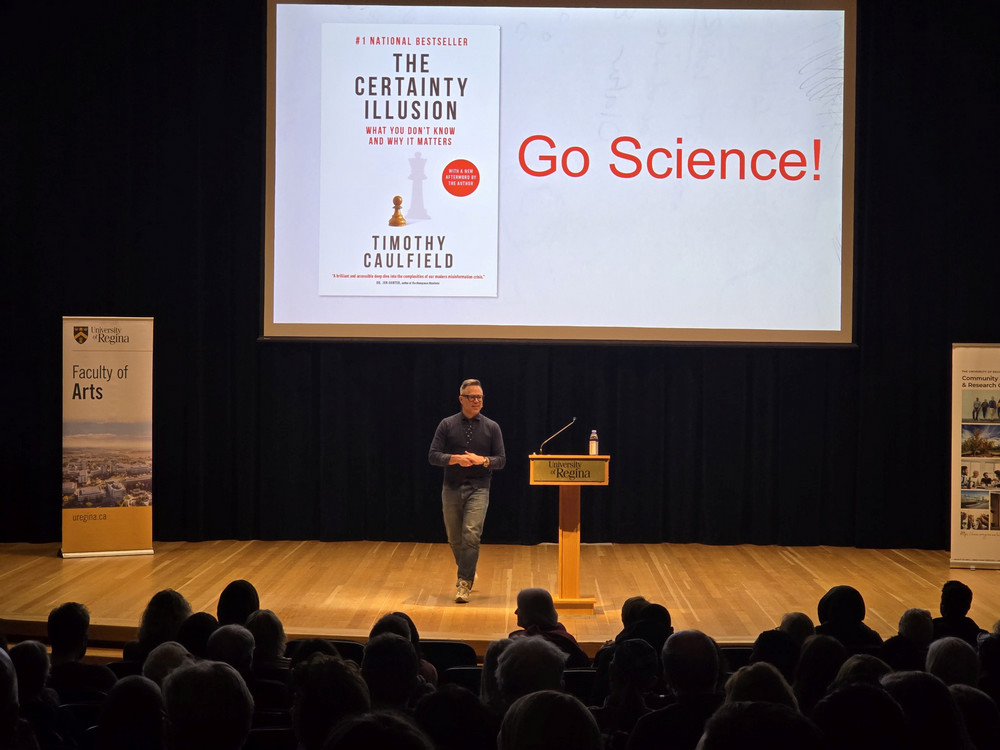
The resonance of Caulfield’s message was palpable during the question-and-answer session that followed. One of the evening’s most memorable moments came from a Grade 11 student from local high school, Campbell Collegiate, who asked for “pillars of truth” to help young people discern misinformation. Caulfield’s practical advice — look for red flags, weigh claims against the consensus, and do lateral reading — was a live masterclass in the kind of digital literacy the Faculty of Arts cultivates every day.
For students, these are not just abstract concepts. They are the core competencies developed within the Faculty of Arts. Programs in the humanities, social sciences, and fine arts are designed to cultivate exactly this kind of analytical rigour and communication expertise, the very skills needed to navigate a complex, information-saturated world.
As McIntosh noted in his closing remarks, the turnout alone proved that the community is hungry for this level of public intellectualism and opportunities to engage and learn more about tough subjects. For the University of Regina, an institution built on the foundation Woodrow Lloyd laid for accessible, public-minded learning, the response to the knowledge crisis begins with exactly this: filling the room, asking the hard questions, and generating opportunities to listen, learn, and ask questions.
Explore how the Faculty of Arts at the University of Regina is equipping students with the critical thinking skills needed to navigate a complex world. Discover programs in humanities, social sciences, and more.
Banner Photo: A full house for the fight against misinformation. Timothy Caulfield delivered the 2026 Woodrow Lloyd Lecture to the largest audience the series has drawn since before COVID. Photo Credit: University Communications and Marketing
About the University of Regina
At the University of Regina, we believe the best way to learn is through access to world-class professors, research, and experiential learning. We are committed to the health and well-being of our more than 16,600 students and support a dynamic research community focused on evidence-based solutions to today’s most pressing challenges. Located on Treaties 4 and 6—the territories of the nêhiyawak, Anihšināpēk, Dakota, Lakota, and Nakoda peoples, and the homeland of the Michif/Métis nation —we honour our ongoing relationships with Indigenous communities and remain committed to the path of reconciliation. Our vibrant alumni community is more than 95,000 strong and enriching communities in Saskatchewan and around the globe.
Let’s go far, together.
Related Posts
Campus Life,
Teaching & Learning
Building a New Chapter in Saskatoon
Research,
Campus Life,
Teaching & Learning
Top 5 Reasons to Study at the U of R: Where Ambition Meets Opportunity
Campus Life,
Teaching & Learning,
Research